Saturday, December 21, 2019

20 of the Best Movies to Watch This Christmas

1. A Charlie Brown Christmas (Charles Schultz)

It's been over 50 years since "A Charlie Brown Christmas" first appeared on TV. It's probably the best of the Charlie Brown movies (although "It's the Great Pumpkin, Charlie Brown" is right up there) and is one of the few Christmas movies that refers to the biblical story. After Charlie Brown asks, "Can anyone tell me what Christmas is all about?," Linus quotes Luke 2:8-14:
And there were in the same country shepherds abiding in the field, keeping watch over their flock by night. And, lo, the angel of the Lord came upon them, and  the glory of the Lord shone round about them: and they were sore afraid. 10And the angel said unto them, Fear not: for, behold, I bring you tidings of great joy, which shall be to all people. For unto you is born this day in the city of David a Savior, which is Christ the Lord. And this shall be a sign unto you; Ye shall find the babe wrapped in swaddling clothes, lying in a manger. And suddenly there was with the angel a multitude of the heavenly host praising God, and saying, Glory to God in the highest, and on earth peace and goodwill towards men.'"
And then Linus concludes, "... and that's what Christmas is all about, Charlie Brown." Note that Linus lets go of his blanket as he says, "Fear not!"
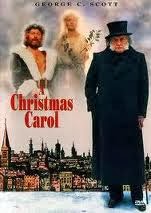
2. A Christmas Carol (George C. Scott, David Warner, Susannah York, Roger Rees)

There are several great versions of Charles Dickens's "A Christmas Carol," but this is my favorite. When George C. Scott's Ebenezer Scrooge yells, "Mr. Cratchit!", there's little doubt that he holds poor Bob in contempt. Plus, Scott is (was) such a great actor. That said, several other versions are worth considering, such as the one with Alastair Sim as Scrooge ("A Christmas Carol"). When I was kid, I was especially taken with "Mr. Magoo's Christmas Carol." An alternative is listening to Jonathan Winters's reading of Dickens's book, which is also quite good.

3. A Christmas Story (Peter Billingsley, Darren McGavin, Melinda Dillon)

Adapted from a memoir by Jean Shepherd (who narrates the film), the movie is primarily about Ralphie Parker (Peter Billingsley), a young boy living in Indiana in the 1940s who desperately wants a Red Rider BB gun for Christmas and tries to convince his parents, teachers, and Santa that it's the perfect gift for him, while they counter that he'll shoot his eye out. In 2012, the film was selected for preservation in the National Film Registry by the Library of Congress for being "culturally, historically, or aesthetically significant." I confess that it isn't one of my favorites, but I'm clearly in a minority on this point, which is why I include it here.

4. Christmas with the Kranks (Tim Allen, Jamie Lee Curtis, Dan Akroyd)

It's too bad that the movie's producers didn't keep the title of John Grisham's book on which the movie is based: "Skipping Christmas" (see picture at right). I think the movie's title leads people to expect one kind of movie when in fact it's something quite different. It tells the story of a couple (Luther and Nora Krank) who, because their daughter (Blair) is going to be Peru for Christmas, working for the Peace Corps, decide to skip Christmas (i.e., don't buy a Christmas tree, hold their annual Christmas party, decorate their house, etc.), and use the money they save to go on a cruise. Their decision to skip Christmas doesn't sit well their neighbors (especially Dan Akroyd), who pressure them to get into the holiday spirit. A battle, of sorts, plays out between the Kranks and their neighbors. Then Luther and Nora get a call from Blair and learn that she's coming home for Christmas, and they now have less than 24 hours to prepare for their annual party. How the neighborhood comes together to pull this off and what Luther does with their cruise tickets speaks volumes about the true meaning of Christmas.

5. Die Hard (Bruce Willis, Alan Rickman, Bonnie Bedelia, Reginald VelJohnson)

OK. Not your traditional Christmas movie. In fact, there is is a growing debate as to whether it really is a Christmas movie (see "Is 'Die Hard' a Christmas Film?") I obviously fall on the side of those who think it it. It takes place on Christmas Eve, is a battle between good and evil, and includes some traditional (and not so traditional) Christmas songs. It stars Bruce Willis as NY police detective John McClane, who flies to LA to reconcile with his wife. He meets her at her company's Christmas party, but while he's changing clothes in the men's room, the party's taken over by a terrorist group (headed by Hans Gruber -- played by Alan Rickman, who a few years later played Severus Snape in the Harry Potter movies), which holds them hostage, all except for McClane, who sneaks away before they know he's there. The rest of the movie is the battle between McClane (good) and Gruber (evil) and includes a lot of classic lines ("Come out to the coast, we'll get together, have a few laughs..."; Yippee ki-yay...").

6. Elf (Will Ferrell, Bob Newhart, James Caan, Zooey Deschanel)

This movie is too fun. Will Ferrell is great as someone (Buddy) who thinks he's one of Santa's elves but is actually a human being who, through a twist of fate, was adopted by an elf (Bob Newhart) when just a baby. Unfortunately, he's not a very good at elf things (e.g., making toys), and once he learns that he's not an elf, he heads to New York where his biological father (James Caan) lives. There he falls in love with Jovie (Zooey Deschanel), helps NY recapture the Christmas spirit, and has a heck of a lot of fun along the way (well, most of the time). The movie is also educational. We learn, for instance, that the four main elvish food groups are candy, candy canes, candy corns, and syrup. There's also allusions to other Christmas classics like "Rudolph, the Red Nose Reindeer" and "Miracle on 34th Street" (see #13 and #14 below).

7. The Family Man (Nicholas Cage, Tea Leoni, Don Cheadle)

One of my favorites. It's is a cross between "It's a Wonderful Life" and "A Christmas Carol." It tells the story of Jack Campbell (JC = Jesus Christ?; his boss/advisor is named Peter), played by Nicholas Cage, who chooses to spend the year after graduating from college in London as an investment banker rather remaining in New York with his girl friend (Tea Leoni). Unsurprisingly, the relationship doesn't last, and when the movie begins (13 years later), Cage is a successful investment banker who loves money and fine things, but cares little for women or family. However, when he wakes up one Christmas morning, he's living the life he would've lived if he hadn't moved to London. He's married (to Tea Leoni), has two kids, and works as a car tire salesman (for his wife's father - Big Ed). Although he initially despises this life, he eventually comes to love it more than the one in which he drove fast cars, wore designer suits, and had his pick of women. The movie's climax occurs after he wakes up back in his old life, tracks down his old girlfriend, and convinces her not to leave for Paris to take a new job.

8. The Family Stone (Claire Danes, Diane Keaton, Rachel McAdams, Dermot Mulroney, Craig T. Nelson, Sarah Jessica Parker, Luke Wilson)

This tells the story about a Christmas gathering of the Stone family when the eldest son (Dermot Mulroney) brings his very uptight girlfriend (Sarah Jessica Parker) home with him to introduce her to his family, as well as propose to her with his grandmother's wedding ring. Parker's reception by Mulroney's family -- played by Diane Keaton (mom, who is dying), Craig T. Nelson (dad), Rachel McAdams (younger sister), Elizabeth Reaser (older sister), Luke Wilson (younger brother), and Tyrone Giordano (youngest brother) -- is chilly, to say the least. So chilly, in fact, that Parker begs her sister (Claire Danes) to join her. Mulroney ends up falling for Danes (and vice versa), Wilson for Parker  (and vice versa), and McAdams for her ex-boyfriend (and vice versa), who is played by Paul Schneider. Chaos ensues, poignancy follows, and although critics greeted it with mixed reviews, over time it has become a holiday favorite for many.

9. Hallmark Christmas Movies (Various)

There isn't one Hallmark Christmas movie, of course. There are hundreds. Hallmark produced 21 new movies in 2016, 33 in 2017, 22 in 2018, and this year it produced 40! A new one premiers almost every night in December. And almost without exception, they're corny and predictable. They're almost always a love story, and one or other of the couple has sworn off Christmas because of some bad experience (e.g., divorce, death in the family). Moreover, you can pretty much count on them breaking up with about 15-20 minutes to go (usually due to some sort of lack of communication) and then getting back together with only a few seconds left on the clock. However, in a world where our President seems to be more bent on exploiting divisions than bringing Americans back together, I can do with a corny (cue the next movie).

10. The Holiday (Cameron Diaz, Jude Law, Kate Winslet, Jack Black, Eli Wallach)

This movie tells the story of two women (Cameron Diaz and Kate Winslet) who, suffering from guy-problems, swap homes with each other (they don't know on another -- they "meet" through an on-line home exchange website) where they each meet someone and fall in love. Diaz's character (Amanda) lives in LA, is a producer of movie trailers, and breaks up with her boy friend after she discovers that he's cheated on her. Winslet (Iris) is a journalist working in London, who's in love with someone who wants to keep her around but doesn't want to commit. When she learns that he's engaged to another journalist, she becomes suicidal, but luckily chooses to spend the holidays in LA instead. A side story concerns elderly gentleman (Eli Wallach--the "ugly" from "The Good, the Bad, and the Ugly"), who lives near Amanda and whom Iris befriends. It turns out that Wallach is a widowed and retired screen writer whom the screen writer's guild wants to honor. He doesn't want to attend, but Iris talks him into it. Personally, I think Wallach should have at least received a best supporting actor nomination for his role, but this isn't the type of movie that actors and actresses win awards for. A pleasant surprise about the movie is that shows that Jack Black can actually act. It's too bad he doesn't get more parts like this.

11. Home Alone (Macaulay Culkin, John Heard, Catherine O'Hara, Joe Pesci, Daniel Stern, Robert Blossom)

When adjusted for inflation, Home Alone is the highest grossing Christmas movie of all time at the North American box office. It tells the story of Kevin McCallister (Macaulay Culkin), an 8-year-old boy who is accidentally left behind when his family flies to Paris for their Christmas vacation. Kevin initially relishes being home alone, but soon has to contend with two highly incompetent burglars (Joe Pesci and Daniel Stern), whom he continues to foil with numerous booby-traps. The rest of his family doesn't realize they left him behind until they are mid-flight to Paris and then struggle to find a flight back (all her booked). Kevin also ends up befriending Old Man Marley (Roberts Blossom), who is rumored to have murdered his family. Like many holiday favorites, it received a mixed reception from critics, but many consider it one of the best Christmas films of all time.

12. How the Grinch Stole Christmas (Boris Karloff)

One of the best holiday movies ever (the animated version, that is, not the one that Opie Taylor directed several years later). In it the Grinch, a cave-dwelling creature with a heart "two sizes too small," lives on Mount Crumpit, a steep mountain above Whoville, home of the Whos. His only companion is his faithful dog, Max. Every year from his perch atop Mount Crumpit, the Grinch hears the "clangy" noisy Christmas festivities that take place in Whoville. Annoyed and unable to understand why the Whos are so happy, he sneaks into town on Christmas Eve and takes all of their Christmas presents, decorations, and food in order to prevent Christmas from coming. However, when Christmas morning arrives, the Whos still celebrate Christmas even though all their presents and decorations have been stolen. Realizing that Christmas is more than gifts and presents, the Grinch's heart grows three times in size, and he returns all the presents and trimmings and joins the Whos for the Christmas feast.

13. It's a Wonderful Life (Jimmy Stewart, Donna Reed, Henry Travers, Lionel Barrymore)

I'm not sure how much I need to say about this movie since it is so well known. Briefly, it stars Jimmy Stewart as George Bailey, a man who has repeatedly given up his dreams in order to help the dreams of others, and whose imminent suicide on Christmas Eve (because of a financial disaster not of his own doing) brings about the intervention of his guardian angel, Clarence Odbody (Henry Travers), who has yet to earn his  wings (he's an angel second class). However, by showing what the world would have been like if George had never been born, Clarence keeps George from committing suicide (and thereby earning his wings). George sees that his life hasn't been a waste but has in fact touched (and improved) the lives of almost all those around him in Bedford Falls. He is, as his younger brother Harry puts it, "The richest man in town." Although the movie opened to mixed reviews, it has become a perennial Christmas classic that captures the true meaning of Christmas. There is a scene at the railroad station when George Bailey learns that his younger brother is not going to take over the family business so that George can go to college. For about 5 seconds, Stewart says nothing; his (i.e., George's) disappointment and frustration only shows in his facial expressions. It's a wonderful example of why Stewart was one of the greatest actors of all time. For more on the movie, see the following post ("It's a Wonderful Life").

14. Last Christmas (Emilia Clarke, Henry Golding, Michelle Yeoh, Emma Thompson)

Most critics disliked this 2019 movie, which is very loosely inspired by Wham's song of the same name, but it's light-hearted (so to speak) with a somewhat surprising twist at the end, which makes it a little different from the typical Christmas movie fare. Emilia Clarke plays Kate, who is a singer who supports herself working as an elf at a year-round Christmas shop. We also eventually learn that she recently received a heart transplant from which she hasn't mentally recovered. She, in fact, appears to be careening through life with something of a death wish. One day, while at work she notices Henry Golding (Tom) outside the shop, whom she gets eventually falls for, but it's never entirely clear whether he feels the same. Nevertheless, he has a positive affect on her, and she slowly gets her life back in order. She stops drinking, having one-night stands, and restores her ties with her mom (Emma Thompson), dad, and sister. Like most Christmas movies, it's ultimately a story about redemption, in this case, Kate's, and the effect this has others. Michelle Yeoh plays "Santa," the owner of the Christmas shop where Kate works. She also played Henry Golding's mother in the movie, Crazy Rich Asians.

15. Love Actually (Numerous)

A 2003 British Christmas-themed romantic comedy explores several separate stories involving a wide variety of individuals, whom we learn as the movie progresses are connected with one another. The movie begins five weeks before Christmas and plays out in a weekly countdown to Christmas, followed by an epilogue that takes place a month later. The movie includes numerous British stars, including Rowan Atkinson, Colin Firth, Martin Freeman, Hugh Grant, Keira Knightley, Laura Linney, Martine McCutcheon, Liam Neeson, Bill Nighy, Emma Thompson, Billy Bob Thornton, and Alan Rickman. You may be skeptical, but recently FiveThirtyEight called it the greatest Christmas movie of all time ("The Definitive Analysis Of ‘Love Actually,’ The Greatest Christmas Movie Of Our Time").

16. Miracle on 34th Street (Maureen O'Hara, John Payne, Edmund Gwenn, Natalie Wood)

Although the 1994 remake of this movie, starring Sir Richard Attenborough (as Santa Claus), Dylan McDermott, and Elizabeth Perkins, is decent, it doesn't come close to the original with Maureen O'Hara and a very young Natalie Wood. The story takes place between Thanksgiving and Christmas Day and focuses on the impact of the Santa Claus hired to work at the Macy's on 34th St. in NY City, who claims to be the real Santa and acts accordingly. For example, he some times he ignores instructions to steer parents to goods that Macy's sells like the time he directs one shopper to another store for a toy fire engine that Macy's doesn't have in stock. And he tells another mother that Macy's rival Gimbels has better skates for her daughter. The film won Academy Awards for Best Actor in a Supporting Role (Edmund Gwenn), Best Writing, Original Story (Valentine Davies) and Best Writing, Screenplay. It was also nominated for Best Picture but lost to Gentleman's Agreement with Gregory Peck.

17. On Her Majesty's Secret Service (George Lazenby, Diana Rigg, Telly Savalas, Gabriele Ferzetti, Ilse Steppat)

"On Her Majesty's Secret Service" (OHMSS) is a "Christmas film" of the way that "Die Hard" is (see above): It involves a battle between good and evil, it's set at Christmas (or quite a bit of it is), it includes Christmas songs, and it even throws in a little bit of redemption. It also involves a chase scene through a Swiss village celebrating the holiday and includes some of the skiing scenes ever. It's worth noting that an article in which The Economist considers whether "Die Hard" is really a Christmas movie, the author makes a brief case for considering OHMSS as a Christmas movie ("Is 'Die Hard' a Christmas Film?"). OHMSS is, of course, the only movie in which George Lazenby plays James Bond. He was chosen after Sean Connery retired from the role after "You Only Live Twice," although Connery changed his mind and came back to play Bond in "Diamonds Are Forever" (1971) and "Never Say Never Again" (1983). Although OHMSS was a commercial success, its reception was mixed. The film's reputation has improved greatly over time, however. The director Christopher Nolan has named it as his favorite Bond movie, and it has slowly moved its way up the "all-time Bond film lists" ("On Her Majesty's Secret Service", "50 Years Later, This Bond Film Should Finally Get Its Due"), and it's no wonder. OHMSS contains some of the best action scenes of the series (which are similar to those of the more recent Bourne movies), Lazenby plays a capable Bond, Diana Rigg's excellent as his love interest and future (and only) wife, and Telly Savalas's "Blofeld" is by far the best of all the Bond films (although Christoph Waltz's portrayal in Spectre is a close second). It also follows the original novel much more closely than the other Bond films. It's definitely worth a watch this Christmas.

18. Rudolph the Red-Nose Reindeer (Burl Ives)

When I was a kid, I couldn't wait for this to come on TV. I only got to see it once a year, and it was a big deal when it came on. Not just for me, but for most of my friends. Now, of course, you can get it (and virtually any other Christmas movie) on DVD or Blue Ray, or download it from iTunes or Amazon, so it (and other Christmas movies) has lost its "specialness." Nevertheless, I still love watching this retelling of the original Robert L. May story ("Rudolph the Red-Nose Reindeer"), in which Rudolph's rejection by his peers (for his shiny nose) leads him to run away from home with by a similarly-outcast elf (Hermey) whose dreams of becoming a dentist. These two eventually join up with a prospector named Yukon Cornelius, and after a battle with the Abominable Snowman, they return home to the North Pole just in time for Rudolph to lead Santa's sleigh through a terrible snow storm, thus keeping Christmas from being cancelled.

19. The Santa Clause (Tim Allen, Judge Reinhold, Eric Lloyd, David Krumholtz)

Tim Allen stars as Scott Calvin, a cynical, divorced, advertising executive for a toy company, who accidentally causes a guy dressed like Santa Claus to fall to his death from his roof on Christmas Eve. Scott and his son Charlie (who is spending Christmas Eve with Scott) discover a sleigh with eight reindeer on the roof, and they conclude that the man must have been Santa Claus. They also find a card in the Santa's suit, instructing that if something should happen to him, that whoever finds the clothes, should put them on and get in the sleigh. Charlie convinces Scott to follow these instructions, and the reindeer take Scott to children's houses around the world to finish Santa's deliveries. After this, the sleigh takes them to the North Pole where they learn that Scott is the new Santa (because of the clause in the instruction card they found -- that is, the "Santa Clause") and convince his former wife that he's the new Kris Kringle.

20. White Christmas (Bing Crosby, Danny Kaye, Rosemary Clooney, Vera-Ellen)

What more can you say about this one? It's got Bing Crosby singing "White Christmas" (not once, but twice); it has Danny Kaye and Vera-Ellen dancing (several times); it has George Clooney's aunt singing and dancing; and it tells a nice, heart-warming story that some may think is  a bit corny. But, to paraphrase Kate Winslet's character in The Holiday (see above), sometimes corny is just what the doctor ordered. The song, "Count Your Blessings" (written by Irving Berlin), was nominated for an Oscar (White Christmas won the Oscar 12 years before for the movie, Holiday Inn), but my favorite (aside from White Christmas) is Snow, sung by Crosby, Kaye, Clooney, and Vera-Ellen on the train from Miami to Vermont (pictured above).

Friday, December 20, 2019

The Persistence of Belief, Part II: Religion is a Natural Accident

Previously ("The Persistence of Belief, Part I: The Future of Religion"), I noted that at least three streams of thought inform the current debate about why belief and religion persist. In this post, I discuss how some believe that religion is an accidental byproduct of a separate (but adaptive) evolutionary process. In future posts, I focus on the work of cultural evolutionists who argue that religion persists because it has helped human groups adapt to various evolutionary pressures ("The Persistence of Belief, Part III: Religion is Good for the Group") and explore the argument that religion persists because it helps us manage and regulate our emotions ("The Persistence of Belief, Part IV: Religion is Good for Us").

Religion is a Natural Accident

In a highly influential essay, evolutionary biologists Stephen J. Gould and Richard Lewontin called traits or characteristics that are byproducts of the evolution of other characteristics, rather than the direct product of adaptive selection, “spandrels.” They borrowed the term from architecture which refers to the V-shaped space formed between two arches. Gould and Lewontin noted that artists often fill such spandrels with paintings or other decorations, but the spandrels are not created for the paintings themselves. Instead, they are byproducts or “accidents” of architectural design. They do not serve a purpose but exist solely because two arches align with one another. Another example of a “spandrel” is the triangular space that is created when staircases are built Such spaces are often filled with closets or cupboards, but they were not constructed in order to create a cupboard or closet. Instead, they are spandrels, or byproducts, resulting from the construction of staircases.

Following Gould and Lewontin, most cognitive scientists of religion (CSRs) consider religious belief be a spandrel, an evolutionary accident that developed alongside one or more “adaptive” characteristics. Most begin with the idea that religious belief is intuitive, that it is cognitively natural, and they draw on cognitive science in order to explain why. By “natural” they do not mean that we are hardwired for religion and that everyone, or at least anyone who is “normal,” is religious. In fact, several CSRs are openly hostile to religion and see cognitive science as a means for explaining religion away. By natural, rather, CSRs have in mind behaviors and thought processes that come easily to us and require little conscious effort on our part.

Robert McCauley has identified two ways in which naturalness can occur. One, which he calls practiced naturalness, comes about through repeated practice and training, such as how we learn to ride a bicycle or break 90 on a golf course. The other, which he calls maturational naturalness, occurs as we mature, such as how we learn to walk or to speak the common language of those around us. Of course, there are some things that come naturally appear to include a little bit of both, such as literacy, which takes both a knowledge of a language but also instruction and practice.

With regards to religion, CSRs argue that religious belief and practice is a natural outcome of the developmental process. The question is, “why?” CSRs do not entirely agree, but many begin with our tendency to attribute agency to ambiguous events. Most CSRs trace this to evolutionary processes to “better be safe than sorry” strategies for dealing with an unknown and hostile world. As the sociologist Christian Smith puts it, "In a hunt-and-be-hunted world in which one may easily become another animal’s next meal, to suspect that unusual objects and movements in one’s environment may be an agent (e.g., a big, predatory cat or a poisonous snake) is a cautious strategy than enhances one’s survival prospects, even when most unusual indicators are not agents." Justin Barrett refers to this as our “hypersensitive agent detection device (HADD),” a term and acronym that has caught on among CSRs. And from there it was only a short step to attributing ambiguous evidence to the agency of superhuman powers.

Another possible contributing factor is what Paul Bloom calls common-sense dualism, which is our tendency to think of bodies and souls as distinct entities. He sees religion as a byproduct “of the fact that we have two distinct cognitive systems, one for dealing with material objects, the other for social entities.” CSRs often refer to these systems as “folk physics” and “folk psychology,” which they see as our our intuitive and automatic understandings of how the world works. Bloom argues that because we see bodies and minds as existing separately, it is not too difficult to imagine one existing without the other. Not only does this make it easy for us to believe in life after death (i.e., souls continuing on without their bodies), it makes it easy for us to believe in God.

Another factor may be our tendency, from a very young age, to think teleologically. We look for and assign meaning and purpose to everyday events. Deborah Keleman has experimentally documented this phenomenon, which she calls, “promiscuous teleology.” As Justin Barrett notes, "preschoolers are inclined to see the world as purposefully designed and tend to see an intelligent, intentional agent as behind this natural design." In other words, our tendency to believe in a God, gods, or supernatural force is not a product of socialization but rather something that develops naturally as part of our cognitive development.

All of this raises the issue as to why after gaining a foothold, religious beliefs continued to persist. CSRs posit at least two possible reasons: One draws on the work of cultural evolutionists (see the next post) and argue that religion, or at least some religions, hold beliefs that enhance a group’s ability to adapt to its environment and thus make it more likely to survive the evolutionary process of natural selection. A second reason is the notion that once they arise, religious concepts are more likely to persist if they strike a balance between naturalness and unnaturalness. The former makes them believable, while the latter makes them memorable. Put somewhat differently, they need to be counterintuitive enough to stand out, but they cannot deviate so far from societal norms that they are incomprehensible; they need to be, as M. Afzal Upal puts it, “minimally counterintuitive” (MCI).

Justin Barrett agrees that MCI beliefs are well suited for surviving evolutionary pressures, but he also believes that highly counterintuitive beliefs can persist if they construct and maintain what he calls, “cultural scaffolding,” that is, those “special artifacts, institutions, practices [and] other devices that help people learn and use these more complex concepts." They are the “extra structures [that] are needed to build up some ideas or practices that are not particularly natural.” What types of scaffolding are needed? Most obviously, ritual and worship, but that is probably not enough:
Successful theological traditions have developed [the] cultural scaffolding to make complex ideas more accessible. A portion of religious activities includes teaching, preaching, or instructive components in which religious ideas are communicated. These institutionalized practices are one part of the cultural scaffolding. Likewise the use of written texts (scripture) and sermons, common features in many religions, is the clearest example of cultural scaffolding that aid in transmitting relatively unnatural theological ideas. (Barrett 2011:141)
In other words, successful religions must put into place practices that help make complex beliefs more understandable and transmittable.

Summary

Although this post does not do justice to the argument as to why CSRs believe that religious beliefs and practices are natural, I think it captures the basic contours of their argument or at least those aspects of it on which most CSR's agree. The figure below attempts to graphically sketch their perspective:


As noted above, a number of CSRs use cognitive science to explain away religion, as do some of the so-called “New Atheists.” such as Richard Dawkins and Daniel Dennett. Not all CSRs agree, however. Justin Barrett, for instance, is a committed Christian and has written extensively on the compatibility of the cognitive science of religion with religious belief and practice. And others have noted that it does not follow that a particular phenomenon is false just because its natural causes have been identified. As the late (and atheist) philosopher J. L. Mackie once remarked, “no account of the origin of a belief can settle the question of whether that belief is true or not.” The Oxford philosopher, Guy Kahane, makes a similar point: “the mere fact that there is a causal explanation of belief does nothing to effect its justification. All beliefs have a causal explanation” (including, one might add, atheistic beliefs). In fact, the psychologist James Jones argues that “if a set of beliefs does perform the functions it was designed for, that certainly counts in favor of its truthfulness." Moreover, we cannot know that they evolved only for survival and reproduction. They could have also evolved for other purposes:
While survival and reproduction are crucial to the species, from the beginning hominids have made music, created art, engaged in ritual and religious practice. Whatever their evolutionary trajectory, and that is lost to us, there is no reason not to see them being as much a part of our early heritage as sex and gathering food. They are not hijacks on our basic nature, they are part of our basic nature. (Jones 2016:126)
Religion's adaptive value is indeed the focus of Steven Asma's recent book, Why We Need Religion, which will be the subject of a future post. Stay tuned.

Bibliography

Barrett, Justin L. 2004. Why Would Anyone Believe in God? Walnut Creek, CA: AltaMira Press.

Barrett, Justin L. 2011. Cognitive Science, Religion, and Theology. West Conshohocken, PA: Templeton Press.

Boyer, Pascal. 1994. The Naturalness of Religious Ideas. Berkeley, CA: University of California Press.

Boyer, Pascal. 2001. Religion Explained. New York: Basic Books.

Gould, Stephen Jay, and Richard C. Lewontin. 1979. "The Spandrels of San Marco and the Panglossian Paradigm: A Critique of the Adaptationist Programme." Proceedings of the Royal Society of London B205(1161):581-98.

Jones, James W. 2016. Can Science Explain Religion? The Cognitive Science Debate. Oxford and New York: Oxford University Press.

Kahane, Guy. 2011. "Evolutionary Debunking Arguments." Noûs 45(1):103-25.

Keleman, Deborah. 1999a. "The Scope of Teleological Thinking in Preschool Children." Cognition 70:241-72. 

Keleman, Deborah. 1999b. "Why Are Rocks Pointy? Children’s Preference For Teleological Explanations of the Natural World." Developmental Psychology 35:1440-53.

Mackie, John L. 1982. The Miracle of Theism. Oxford, UK: Oxford University Press.

McCauley, Robert. 2011. Why Religion is Natural and Science is Not. Oxford: Oxford University Press.

Smith, Christian S. 2017. Religion: What it Is, How it Works, and Why It Matters. Princeton, NJ: Princeton University Press.

Upal, M. Afzal. 2010. "An Alternative Account of the Minimal Counterintuitiveness Effect." Cognitive Systems Research 11(2):194-203.

Thursday, December 19, 2019

The Persistence of Belief, Part I: The Future of Religion

It's no secret that religious affiliation rates have been falling in the United States over the last few years, and some have equated this drop with a decline in religious belief. That, however, is incorrect. Those who no longer claim a religious affiliation are often still quite religious. For example, of the 20% of Americans who in 2012 claimed no religious affiliation, 18% considered themselves religious, 30% had had a religious or mystical experience, 33% said they believed that religion is somewhat or very important, 37% considered themselves to be spiritual but not religious, 41% prayed weekly or more, and 68% said they believed in God.

And if you're wondering, unaffiliated European display similar patterns. Over half of Western Europeans surveyed in 2008 who reported no religious affiliation affirmed at least one of the following statements:
  • I have my own way of connecting with God without churches or religious services
  • I believe in life after death
  • I believe in reincarnation -- being born reborn in this world again and again
  • I believe in the supernatural power of deceased ancestors
  • Good luck charms sometimes do bring good luck
  • Some fortune tellers really can foresee the future
  • Some faith healers do have God-given healing powers
  • A person’s star sign at birth, or horoscope, can affect the course of their future
This should not come as a surprise. Research has found that novel (or deviant) forms of belief tend to thrive in those areas where more traditional forms are weak. As Rodney Stark and William Bainbridge pointed out back in 1985, seldom do people stop believing; instead, they tend to trade their beliefs in for “newer” or “different” ones. And they showed that there is a strong correlation between church membership rates and participation in untraditional forms of belief (at least untraditional in the U.S.) such as Yoga, Transcendental Meditation, Scientology, Astrology, and so on.

Subsequently, one of Stark's students, Christopher Bader, used Yellow Page advertisements to develop a rate of astrology studies for each of the 50 U.S. states. And when compared with state adherence rates, it exhibits a strong negative correlation. The figure below presents this graphically where the map on the left plots the adherence rate by state, while the map on the right plots the astrology rate by state. The darker the shade of blue, the higher the rate. In general, where church adherence rates are high (e.g., Louisiana), astrology rates low, but where church membership rates are low (e.g., Alaska), astrology rates are high.


More recently, using search data from Google Trends, which social scientists are increasingly using to explore a number of social phenomena, I compared the proportion of searches by state over the last 5 years for “Churches” with “Astrologers,” “Psychic,” “New Age,” “Yoga,” and “Zen.” The figure below presents the results where positive correlations are colored blue and negative correlations are colored red. (Note: Correlation coefficients range from -1.00 to 1.00. A correlation of 1.00 indicates perfect positive correlation, while a correlation of -1.00 indicates perfect negative correlation.) As the figure indicates, searches for “churches” are negatively correlated with searches for all five of the other terms.


In short, belief in something beyond the everyday is quite common. In fact, one could argue it is the norm. The question is why? It is not, as some would have us believe, due to a lack of education or a better understanding of science, nor simply because it offers comfort in the face of a meaningless universe ("Stephen Hawking and the Questions Science Can (and Cannot) Answer"). As Darwin, himself, noted it appears that religion’s appeal is rooted much deeper in our evolutionary history.
Nor must we overlook the probability of the constant inculcation in a belief in God on the minds of children producing so strong and perhaps an inherited effect on their brains not yet fully developed, that it would be as difficult for them to throw off their belief in God, as for a monkey to throw off its instinctive fear and hatred of a snake.
At least three streams of thought inform the current debate about what evolutionary processes played a part. One, which is associated with cognitive scientists of religion, argues that religion is “natural” in the sense that it is an accidental byproduct of a separate (but adaptive) evolutionary process ("The Persistence of Belief, Part II: Religion is a Natural Accident"). A second, which draws primarily on the work of group or cultural evolutionists who contend that religion, or at least some forms of it, have helped human groups to adapt to various evolutionary pressures ("The Persistence of Belief, Part III: Religion is Good for the Group"). The third reflects the efforts of philosopher Stephen Asma, who argues that religion persists because it is good for us because it helps us manage and regulate our emotions ("The Persistence of Belief, Part IV: Religion is Good for Us"). All three of these explanations are not entirely incompatible with one another, but it is helpful to consider them as analytically distinct and examine their arguments separately. That's the purpose of three soon to follow posts.

Tuesday, December 17, 2019

Geniuses for Jesus (2019 Version)

A common assumption in some circles is that religion and education/science are incompatible, but as the late evolutionary biologist Stephen J. Gould (who was, at most, an agnostic) once remarked (Scientific American, 1992):
To say it for all my colleagues and for the umpteenth millionth time. . . science simply cannot (by its legitimate methods) adjudicate the issue of God’s possible superintendence of nature. We neither affirm nor deny it; we simply can’t comment on it as scientists... Either half my colleagues are enormously stupid, or else the science of Darwinism is fully compatible with conventional religious beliefs—and equally compatible with atheism, thus proving that the two great realms of nature’s factuality and the source of human morality do not strongly overlap.  
Gould isn't the final word on the matter, but social scientists of religion have known for some time that there's a positive association between education and religious belief and practice. For whatever reason, however, this has failed to make its way to the larger population.

My intention in this (updated) post, however, isn't to reiterate known facts but to provide a series of brief biographies of "geniuses" who are/were also Christians. Some are scientists (e.g., Steven Barr, Francis Collins, John Polkinghorne), some are philosophers (e.g., René Girard, Alasdair MacIntyre, Gabriel Marcel, Edith Stein, Charles Taylor), some are writers (e.g., Maya Angelou, Flannery O'Connor, Dorothy Day, Marilynne Robinson, Dorothy Sayers, John Updike), and some are hard to classify (e.g., Jane Addams, Jaques Ellul, C.S. Lewis, Fred Rogers, John Sexton, J.R.R. Tolkien). Many are Roman Catholics, which may surprise some given the disdain that much of contemporary culture hurls at them. And there are some who I didn't include but probably will in the future (e.g., Peter Berger, Galileo Galilei, Isaac Newton, Søren Kierkegaard, Cornell West). I have shied away from professional theologians, but I do include Fred Rogers who earned a theological degree and was ordained a Presbyterian minister. He doesn't strike me as a professional theologian although others might disagree.

Finally, although this post focuses on Christian intellectuals, one could just as easily write about intellectuals who are affiliated with other faiths (e.g, the Jewish philosophers Martin Buber and Emmanuel Levinas), but I'll leave it someone else to take up that task.

Note: The following information was gleaned from numerous sources, such as Wikipedia, news reports, websites about the individuals, etc. They (hopefully) appear in alphabetical order.

Jane Addams (Presbyterian)—Addams is probably best known as the co-founder of Hull House in Chicago, a settlement house that opened its doors to recent immigrants from Europe. She was also a social activist/reformer, social worker, public philosopher, sociologist, author, leader in women's suffrage, all of which led to her being awarded the Nobel Peace Prize in 1931. What's left out of many textbooks is that she was also a Christian. Her religious faith was a central motive in co-founding Hull House, and in fact she sought to convert others to Christianity. Addams's personal beliefs were shaped by her wide reading and life experience. By the time she had graduated from Rockford Seminary, she knew the Bible thoroughly. Although she remained a member of a Presbyterian church, Addams regularly attended a Unitarian church in Chicago. She also established a close relationship with members of the established Jewish community, notably with the rabbi of Chicago Sinai Congregation, Emil G. Hirsch, and several of the congregation's members.

Maya Angelou (Baptist)—Angelou is probably best known for her series of autobiographies, the first of which, I Know Why the Caged Bird Sings, tells about her life up to the age of 17. She became a poet and writer after holding a series of occupations as a young adult, including fry cook, prostitute, nightclub performer, and coordinator for the Southern Christian Leadership Conference. She was active in the Civil Rights movement and worked with Martin Luther King, Jr. and Malcolm X. From 1982 onward she taught at Wake Forest where she held the lifetime Reynolds Professorship of American Studies. She taught a variety of subjects, including philosophy, ethics, theology, science, theater, and writing. In 1993 she recited her poem "On the Pulse of Morning" (1993) at President Bill Clinton's inauguration, becoming the first poet to give an inaugural recitation since Robert Frost gave one at President John F. Kennedy's 1961 inauguration. Angelou used the same "writing ritual" for many years. She'd wake early in the morning and check into a hotel room, where the staff was instructed to remove any pictures from the walls. She would write on legal pads while lying on the bed, with only a bottle of sherry, a deck of cards, Roget's Thesaurus, and the Bible. She averaged 10–12 pages of written material a day, which she would edit down to three or four in the evening. Angelou was a member of both Mount Zion Baptist Church in Winston-Salem (for over 30 years) and Glide Memorial United Methodist Church in San Francisco. Both held services after she passed away in May 2014.

Stephen M. Barr (Roman Catholic)Stephen Barr is a professor in the Department of Physics and Astronomy at the University of Delaware, and a member of its Bartol Research Institute. He does research in theoretical particle physics and cosmology and in 2011 was elected Fellow of the American Physical Society, the world's second largest organization of physicists. Barr obtained his Ph.D. in physics from Princeton University in 1978. He went on to do research at the University of Pennsylvania as a post-doctoral fellow (1978–80), the University of Washington as a Research Assistant Professor (1980-85), and Brookhaven National Laboratory as an Associate Scientist (1985-87), before landing at the University of Delaware in 1987. Barr is a Roman Catholic and writes about religion and science. He is the author of Modern Physics and Ancient Faith, and he serves on the Editorial Advisory Board of the religious journal, First Things, in which many of his articles have appeared. In 2007, he was awarded the Benemerenti Medal by Pope Benedict XVI, and in 2010 he was elected a member of the Academy of Catholic Theology.

Francis S. Collins (Evangelical)Collins is an American physician/geneticist noted for his discoveries of disease genes and his leadership of the Human Genome Project. He is currently the director of the National Institutes of Health (NIH) in Bethesda, Maryland. He earned his Ph.D. in Physical Chemistry at Yale in 1974 and then enrolled in medical school at the University of North Carolina at Chapel Hill, from which he graduated in 1977. He became known as a gene hunter when working at the University of Michigan, which led him to be to be appointed the director of the National Human Genome Research Institute (NHGRI). He has been elected to the Institute of Medicine and the National Academy of Sciences, and has received the Presidential Medal of Freedom and the National Medal of Science. Collins's parents were, at best, nominal Christians, and by graduate school he considered himself an atheist. Dealing with his dying parents, however, led him to investigate various faiths, and C.S. Lewis's book, Mere Christianity, played an instrumental role in him becoming a Christian. H has written several books on science, medicine, and spirituality, including the bestseller, The Language of God: A Scientist Presents Evidence for Belief.

Dorothy Day (Roman Catholic)Dorothy Day was an American journalist, social activist, who after living something of a bohemian life in New York, converted to Catholicism and helped give birth to the Catholic Worker Movement, a pacifist movement that continues to combine direct aid for the poor and homeless with nonviolent direct action on their behalf. Her parents were nominal Christians who rarely attended church, but as a young child she displayed a religious streak, reading the Bible frequently. When she was ten she started to attend an Episcopal church, after her brothers join the church choir. She eventually was baptized and confirmed in that church. She quickly drifted away from the faith, however, and she soon described herself as an anarchist and a socialist. She worked for several Socialist publications and wrote in support of women's rights, free love, and birth control. She had long love affair with Mike Gold, who later became a prominent Communist, and in the early 1920s, after the end of a love affair that resulted in an abortion, she was married in a civil ceremony to Berkeley Tobey. The marriage evidently didn't take because she soon became involved with Forster Batterham, but their relationship became strained when Day became increasingly interested in Roman Catholicism. Soon after the birth of their daughter Tamar Teresa, she had their baby baptized in July 1927, but Batterham refused to attend the ceremony. And after one last fight in late December, Day was baptized into the Catholic Church.

Jaques Ellul (Reformed)Ellul was trained as a sociologist although many consider him a philosopher. He was a professor of History and the Sociology of Institutions on the faculty of Law and Economic sciences at the University of Bordeaux. He authored 58 books and more than a thousand articles. Many of these focused on the threat to human freedom and religion created by modern technology. Ellul was educated at the universities of Bordeaux and Paris, and during World War II he was a leader in the French resistance. For his efforts to save Jews he was awarded the title, "Righteous among the Nations," by Yad Vashem in 2001. He converted to Christianity when he was about 20. According to Ellul, a few years before, while translating Faust, Ellul knew he was in the presence of a something so astounding and overwhelming that he jumped on a bike and fled, eventually concluding that he had been in the presence of God. This kick started a conversion process that continued over the next few years. Ellul was heavily influenced by the work of three people: Karl Marx, Søren Kierkegaard, and Karl Barth. Marx and Kierkegaard were the only two authors of which he read all of their work, and he considered Barth the greatest theologian of the 20th century. Ellul was active in the worldwide ecumenical movement although he later criticized it for its often uncritical endorsements of leftist positions. He was, however, also critical of those on the right, and he staked out an explicitly anti-political stance as an alternative to both. Ellul is also credited with coining the phrase, "Think globally, act locally."

René Girard (Roman Catholic)Girard was born on December 25, 1923, in Avignon, France. He studied in Paris’s École Nationale des Chartes and specialized in Medieval studies. In 1947, he emigrated to America and earned a doctorate at the University of Indiana. He remained in America and taught at several different institutions, including Indiana University, State University of New York in Buffalo, Duke, Johns Hopkins, Bryn Mawr, and Stanford until his retirement in 1995. During the beginning of his career as lecturer, Girard was assigned to teach courses on European literature. As he read the great European novels in preparation for the course, he became especially engaged with the work of five novelists in particular: Cervantes, Stendhal, Flaubert, Dostoyevsky and Proust. His first book, Mensonge Romantique et Vérité Romanesque (Deceit, Desire and the Novel: Self and Other in Literary Structure) (1961), is a literary comment on the works of these great novelists. Until that time, Girard was a self-declared agnostic. As he researched the religious conversions of some of Dostoyevsky’s characters, he converted to Christianity and ever since has been a committed and practicing Roman Catholic. However, his Christian views were not publicly expressed until the publication of Des Choses Cachées Depuis la Fondation du Monde (Things Hidden from the Foundation of the World) (1978), widely considered to be his greatest work. In 2005, Girard was elected to the Académie Française, one of the highest distinctions that French intellectuals can attain.

C. S. Lewis (Anglican)As an undergraduate student at Oxford University Lewis won an unprecedented triple first, that is, the highest honors in three areas of study: Greek and Latin literature in 1920, Philosophy and Ancient History in 1922, and English in 1923. He was then elected a Fellow of Magdalen College, Oxford, where he worked for nearly thirty years until 1954 when he was awarded the newly founded chair of Medieval and Renaissance Literature at Cambridge University and elected a fellow of Magdalene College. As a scholar he concentrated on the later Middle Ages, but he is probably best known for his Christian apologetics (e.g., Mere Christianity) and the Chronicles of Narnia. Lewis was raised in a church-going family in the Church of Ireland (Anglican), but he became an atheist at 15, describing himself as being "very angry with God for not existing." He slowly re-embraced Christianity, influenced largely by arguments with his colleague and friend J. R. R. Tolkien (see below) and the book, The Everlasting Man, by G. K. Chesterton. He first converted to theism in 1929 and then to Christianity in 1931, following a late-night discussion with Tolkien and another friend. He became a member of the Church of England, much to the disappointment of Tolkien, who had hoped he would become a Roman Catholic. Lewis is commemorated on the 22nd of November in the Episcopal Church's church calendar, which marks the day he died in 1963 (the same day that John F. Kennedy was assassinated). On the 50th anniversary of his death, Lewis was honored with a memorial in Poets' Corner at Westminster Abbey.

Alasdair MacIntyre (Roman Catholic)MacIntyre is a Scottish philosopher known primarily for his moral and political philosophy but known also for his work in history of philosophy and theology. He was educated at Queen Mary College, London, and has Master of Arts degrees from the University of Manchester and the University of Oxford. He began teaching in 1951 in the UK and then moved to the US in 1970. He has taught at numerous universities, including University of Manchester, Oxford, Vanderbilt, and Notre Dame. He was a relatively well-known Marxist philosopher for years until his "conversion" to Aristotelean ethics, which he articulated in his most famous book, After Virtue. Shortly thereafter he converted to Roman Catholicism after he became a fan of Thomas Aquinas. His conversion to Aristotelian ethics and the Roman Catholic Church hasn't led him to completely abandon his Marxist leanings, however. He has, for instance attempted to combine historical insights of Marx with those of Aquinas and Aristotle, and he does nothing to hide his contempt for liberal capitalism, which he believes dominates the world both in the realm of ideas and in its manifestations in political and social institutions. Thus, although he is in many ways a traditional Catholic, his politics often leans to the left.

Gabriel Marcel (Roman Catholic)Gabriel Honoré Marcel was born in Paris in 1889 and is remembered as a philosopher, playwright, music critic, and Christian existentialist. He authored over a dozen books and at least thirty plays, but he is best known for his two-volume work, The Mystery of Being (1951), the 1949–50 Gifford Lectures, one of the most prestigious lecture series in the world. Marcel's mother died when he was young, and he was raised by his aunt and father. His father was an agnostic, and Marcel was an atheist until he covered to Roman Catholicism in 1929. Marcel obtained the agrégation in philosophy in 1910 at the age of 21. During the WWI he worked with the Red Cross to convey news of injured soldiers to their families. He then taught in secondary schools, was a drama critic for various literary journals, and worked as an editor for Plon, a major French Catholic publisher. For many years, he hosted a weekly philosophy discussion group through which he met and influenced important younger French philosophers like Jean Wahl (Jew), Paul Ricoeur (Christian), Emmanuel Levinas (Jew), and Jean-Paul Sartre (Marxist). Evidently, Marcel was disappointed that he was known almost entirely for his philosophical works and not on his plays, which he hoped would appeal to a wide lay audience.

Flannery O'Connor (Roman Catholic)—Flannery O'Connor was an American writer and essayist, who wrote two novels—Wise Blood (1952) and The Violent Bear It Away (1960)—and 32 short stories, some of which are collected in A Good Man Is Hard to Find (1955) and Everything That Rises Must Converge (1965). Her posthumously published collection of short stories, The Complete Stories, won the 1972 U.S. National Book Award for Fiction. O'Connor was born in 1925, in Savannah, Georgia, and her writing reflects her Southern roots. In 1945 she graduated with a degree in social sciences from Georgia State College for Women (Georgia College & State University), in an accelerated three-year program. In 1946, she was accepted into the prestigious Iowa Writers' Workshop at the University of Iowa where she got to know a number of important writers and critics who lectured or taught in the program, including Andrew Lytle, who was the editor of the Sewanee Review in which he published several of her short stories. In 1951, she was diagnosed with systemic lupus erythematosus, the same disease her father died of. She was only expected to live 5 more years but lasted 14, dying at the far too young age of 39. O'Connor was a devout Roman Catholic. She collected books on Catholic theology and gave lectures on faith and literature, sometimes traveling quite distances in spite of her poor health. In 2013 her prayer journal ("A Prayer Journal"), which she kept while in Iowa and was just recently discovered among her papers, was published to rave reviews.

John Polkinghorne (Anglican)The Rev. Dr. John Charlton Polkinghorne is an English theoretical physicist, theologian, writer, and Anglican priest. A prominent and leading voice explaining the relationship between science and religion, he taught mathematical physics at the University of Cambridge from 1958 to 1979. For 25 years, he worked on theories about elementary particles, played a role in the discovery of the quark, and researched the analytic and high-energy properties of Feynman integrals and the foundations of S-Matrix theory (whatever that is). He also spent time at Princeton, Berkeley, Stanford, and at CERN in Geneva, and in 1974 he was elected a Fellow of the Royal Society, which is the oldest an probably the most prestigious society for science in the world. In 1979 he resigned his chair in order to study for the priesthood, and in 1982 he was ordained an Anglican priest. He is the author of several book on physics and theology (e.g., Belief in God in an Age of Science), the latter of which tend to focus on the relationship between science and religion. He delivered the prestigious Gifford Lectures in 1993-94, he was knighted in 1997, and in 2002 he was awarded the Templeton Prize, which is something of the Nobel Prize for religion; it is awarded to a living person who, in the estimation of the judges, "has made an exceptional contribution to affirming life's spiritual dimension."

Marilynne Robinson (Congregationalist)—Robinson was born in 1943 and is an American novelist and essayist. She has received several awards including the Pulitzer Prize for Fiction and the 2012 National Humanities Medal. She was born and grew up in Sandpoint, Idaho, and earned her undergraduate degree in 1966 (magna cum laude) at Pembroke College, the former women's college at Brown University, where she was elected to Phi Beta Kappa. She earned a Ph.D. in English from the University of Washington in 1977. Robinson has written three highly acclaimed novels: Housekeeping (1980), Gilead (2004), Home (2008), and Lila (2014). Housekeeping was a finalist for the 1982 Pulitzer Prize for Fiction (US), Gilead won the 2005 Pulitzer, and Home received the 2009 Orange Prize for Fiction (UK). Lila, which was just released this year, has received excellent review. Home and Lila are companions to Gilead and focus on different aspects of the family of a Congregationalist minister. Robinson grew up in the Presbyterian church but later became a Congregationalist, worshipping and sometimes preaching at the Congregational United Church of Christ in Iowa City. Her Congregationalism, and her interest in the Protestant Reformer John Calvin, have influenced her writing. In an interview with the Church Times in 2012, Robinson said: "I think, if people actually read Calvin, rather than read Max Weber, he would be rebranded. He is a very respectable thinker."

Fred Rogers (Presbyterian)—Some may not consider Rogers a genius since he isn't remembered as an intellectual. However, he was certainly a genius when it came to children, and he certainly didn't lack in the education department. He also wrote over 200 songs, and 13 operas! Rogers was born in Latrobe, Pennsylvania (Arnold Palmer's home town). He attended Dartmouth College for a year before transferring to Rollins College where he graduated magna cum laude and earned a bachelor's degree in music in 1951, after which he began his television career at NBC in New York. At Rollins he met Sara Joanne Byrd from Jacksonville, Florida, and they were married in 1952, which lasted until Rogers's death in 2003. After two years in New York, Rogers moved to Pittsburgh in order to work for the television station WQED where he helped develop the children's shows, The Children's Corner (1955) and Misterogers (1963). In 1963 he graduated from Pittsburgh Theological Seminary and was ordained a Presbyterian minister. He then began attending the University of Pittsburgh's Graduate School of Child Development, where he began his 30-year long collaboration with the child psychologist Margaret McFarland, and in 1968 he created Mister Rogers' Neighborhood, which ran for 33 years and praised for focusing on numerous children's emotional and physical concerns. Recently, Rogers's work has been the focus of books, a documentary (Won't You Be My Neighbor?), and a feature-length movie, A Beautiful Day in the Neighborhood, starring his sixth cousin, Tom Hanks.

Dorothy Sayers (Anglican)Although she was a poet, playwright, essayist, translator (e.g., Dante's, The Divine Comedy), and worked in advertising (she is credited with coining the phrase, "it pays to advertise"), she is best known for her mystery novels featuring the Lord Peter Wimsey, which are still in print and continue to remain popular; in fact, several have been turned into BBC and PBS movies. Sayers also wrote several essays and plays on the Christian faith, including Creed or Chaos? (1940), The Mind of the Maker (1941), and The Man Born to be King (1942). In fact, her religious works presented the orthodox Anglican theological position so well that, in 1943, the Archbishop of Canterbury offered her a Lambeth doctorate in divinity, but she declined. Although not a member of the Inklings, she was good friends with many of them, including C.S. Lewis and J.R.R Tolkien. Sayers was born in 1893 at the Head Master's House, Christ Church Cathedral, Oxford, where her father was chaplain and headmaster of the Choir School. When she was six, her father began teaching her Latin, and in 1912 she won a scholarship to Somerville College, Oxford where she studied modern languages and medieval literature and finished with first-class honors. At the time women Oxford did not award women degrees, in 1920 when the policy changed, Sayers became one of the first women to receive a degree (Master of Arts) from Oxford.

John Sexton (Roman Catholic)—John Sexton is New York University's (NYU) 15th President. He joined the University's Law School in 1981, was named the Dean of NYU's Law School in 1988, and became NYU's president in 2001. While he was the Law School's Dean (1988-2002), it was named one of the top 5 law schools in the country by U.S. News and World Report, since he has taken over as the school's President, NYU has been named the “number one dream school” four times by The Princeton Review. And in November 2009, Time Magazine named Sexton one of the 10 Best College Presidents. Sexton earned a B.A. in History in 1963 from Fordham College; an M.A. in Comparative Religion in 1965 and a Ph.D. in History of American Religion in 1978 from Fordham University; and a J.D. (magna cum laude) in 1979 from Harvard Law School. Unlike a lot of university presidents, he continues to teach a full course-load, including the exceedingly popular (and hard to get into) class, "Baseball as a Road to God," which was featured on Bill Moyers Journal and was later turned into a book of the same name. The class had its genesis in a crack about baseball that a student made to Sexton several years ago:
I hear you're a big baseball fan. I think the sport is silly and I don't understand why anybody would waste time on it. 
To which Sexton replied,
You are among the unwashed...   
If you will read twelve books that I choose next semester, I will direct you in an independent study at the end of which you will realize that baseball is a road to God.
And the rest, as they say, is history ("Baseball as a Road to God").

Edith Stein (Roman Catholic)—Stein was was a German Jewish philosopher who converted to Roman Catholicism, became a Carmelite nun, and was canonized as a martyr and a saint. In 1916 she received a doctorate of philosophy from the University of Freiburg under the direction of the philosopher Edmund Husserl. She also worked with Martin Heidegger editing Husserl's papers for publication. It was her reading of Teresa of Ávila's autobiography in the summer of 1921 that led to her conversion. Baptized on New Year's Day in 1922, she first taught at the Dominican nuns' school in Speyer from 1923 to 1931. In 1932 she became a lecturer at the Institute for Educational Studies at the University of Munster, but antisemitic legislation passed by the Nazi's forced her to resign the post in 1933. In 1933 she entered the Carmelite monastery St. Maria vom Frieden (Our Lady of Peace) in Cologne, taking the name, Teresa Benedicta of the Cross. There she wrote, Finite and Eternal Being, in which she attempted to combine the philosophies of St. Thomas Aquinas, Duns Scotus and Husserl. In 1938, in order to protect her from the Nazis, the Carmelites transferred Stein and her sister (also a convert) to their monastery in Echt, Netherlands. The Nazis invaded the Netherlands two years later, and in 1942 they arrested Stein and her sister. In August of that year, she died in a gas chamber at Auschwitz. She was beatified as a martyr in 1987 and then canonized in 1998. She is one of Europe's six patron saints, and in 2006 the philosopher Alasdair MacIntyre (see above) published the book, Edith Stein: A Philosophical Prologue, 1913-1922, in which he contrasted her life with that of Martin Heidegger, a Nazi sympathizer.

Charles Taylor (Roman Catholic)—Taylor is a Canadian philosopher who has been awarded the Kyoto Prize (arts and philosophy category), which is Japan’s highest private award for global achievement, and the Templeton Prize, which is is awarded to a living person who, in the estimation of the judges, "has made an exceptional contribution to affirming life's spiritual dimension, whether through insight, discovery, or practical works." He also delivered the prestigious Gifford Lectures in 1998-99 (and again in 2008-09), which became the basis of three books: Varieties of Religion Today: William James RevisitedModern Social Imaginaries; and A Secular Age. Many people (e.g., Robert Bellah) believe the latter is already one of the most important books ever written on social and philosophical theory. Taylor earned his undergraduate degree at McGill University (B.A. in History in 1952) and then studied at Oxford, first as a Rhodes Scholar at Balliol College in 1955 (B.A. in Philosophy, Politics and Economics), and then as a post-graduate (D.Phil. in 1961) where he studied under Isaiah Berlin and G. E. M. Anscombe. He was the founder of the Universities and Left Review (predecessor to the New Left Review) and a vice-president of the New Democratic Party. Perhaps his best known student is Michael Sandel, whose "Justice" series (the Harvard class, the PBS series, and the book) turned Sandel into something of an academic rock star and helped raise Taylor's profile outside of the academy.

J. R. R. Tolkien (Roman Catholic)—John Ronald Reuel Tolkien is best known for his books, The Hobbit and The Lord of the Rings, but he was also a professor of English Literature at Oxford for a number of years. Tolkien's first job after WWI was at the Oxford English Dictionary, where he worked primarily on the history and etymology of words of Germanic origin beginning with the letter "W." In 1920, he took up a post as Reader in English Language at the University of Leeds, and became the youngest professor there. In 1925, he returned to Oxford as Rawlinson and Bosworth Professor of Anglo-Saxon, with a fellowship at Pembroke College. While at Pembroke, Tolkien wrote The Hobbit and the first two volumes of The Lord of the Rings. As most people know, Tolkien was a devout Catholic, and he played a significant factor in the conversion of C. S. Lewis. Tolkien vocally opposed Adolf Hitler and the Nazi Party prior to WWII, and he especially despised Nazi racist and anti-Semitic ideology. He retired in 1953 and lived comfortably because of the sales of his books. He became a cult figure among the counter-culture movement of the 1960s, something with which he wasn't too pleased. He was, after all, a traditional Catholic.

John Updike (Episcopalian)John Updike was an American novelist, poet, short story writer, art critic, and literary critic. He is considered one of the greatest American fiction writers of his generation and is best known for his "Rabbit" novels (Rabbit, RunRabbit ReduxRabbit Is RichRabbit At Rest). He is one of only three authors (Booth Tarkington and William Faulkner were the others) to win the Pulitzer Prize for fiction more than once. Updike was also a Christian and theological themes pervaded his books (see e.g., Roger's Version). In fact, at a 2004 talk at St. Bartholomew’s Episcopal Church in Manhattan, he told the audience that his Christian faith had “solidified in ways less important to me than when I was 30, when the existential predicament was realer to me than now. … I worked a lot of it through and arrived at a sort of safe harbor in my life... When I haven’t been to church in a couple of Sundays, I begin to hunger for it and need to be there... It’s not just the words, the sacraments. It’s the company of other people, who show up and pledge themselves to an invisible entity.” Unlike many of his mainline Protestant contemporaries, Updike wasn't afraid to affirm tenets of the Christian faith, such as Christ's bodily resurrection, which many find embarrassing if not downright intellectually irresponsible:

Make no mistake: if he rose at all
It was as His body;
If the cell’s dissolution did not reverse, the molecule reknit,
The amino acids rekindle,
The Church will fall.

It was not as the flowers,
Each soft spring recurrent;
It was not as His Spirit in the mouths and fuddled eyes of the
Eleven apostles;
It was as His flesh; ours.

The same hinged thumbs and toes
The same valved heart
That—pierced—died, withered, paused, and then regathered
Out of enduring Might
New strength to enclose.

Let us not mock God with metaphor,
Analogy, sidestepping, transcendence,
Making of the event a parable, a sign painted in the faded
Credulity of earlier ages:
Let us walk through the door.

The stone is rolled back, not papier-mache,
Not a stone in a story,
But the vast rock of materiality that in the slow grinding of
Time will eclipse for each of us
The wide light of day.

And if we have an angel at the tomb,
Make it a real angel,
Weighty with Max Planck’s quanta, vivid with hair, opaque in
The dawn light, robed in real linen
Spun on a definite loom.

Let us not seek to make it less monstrous,
For our own convenience, our own sense of beauty,
Lest, awakened in one unthinkable hour, we are embarrassed
By the miracle,
And crushed by remonstrance.

-- "Seven Stanzas at Easter," John Updike (1960)

Monday, December 9, 2019

101 Holiday Songs for the Christmas Season

Although the continuous playing of Christmas songs can get a bit annoying, I still love listening to them and occasionally joining in. Here's a list of 101 of some enjoyable holiday songs, which hopefully appear in alphabetical order. The list is slightly changed from last year, and all but one of the songs should link to iTunes Preview, so you can listen to (or at least preview) the songs:
  1. All I Want for Christmas Is You - Mariah Carey
  2. Almost There - Michael W. Smith and Amy Grant
  3. Angels We Have Heard on High - Glee Cast
  4. Auld Lang Syne - Colbie Caillat
  5. Ave Maria - The Carpenters
  6. Away in a Manger/Child in a Manger - Michael W. Smith
  7. Baby, Just Go Outside - The Holderness Family
  8. Believe - Josh Groban
  9. Blue Christmas - Elvis Presley
  10. Breath of Christmas - Amy Grant
  11. Carol of the Bells - The Carpenters
  12. Carols Sing - Michael W. Smith
  13. Celebrate Me Home - Kenny Loggins
  14. The Chanukah Song - Adam Sandler
  15. Christ is Born - The Carpenters
  16. Christmas (Baby Please Come Home) - U2
  17. Christmas Can't Be Very Far Away - Amy Grant
  18. Christmas Canon - Trans-Siberian Orchestra
  19. Christmas Hymn - Amy Grant
  20. Christmas in Dixie - Alabama
  21. Christmas in Your Arms - Alabama
  22. Christmas is Coming - Vince Guaraldi Trio
  23. Christmas Island - Jimmy Buffett
  24. The Christmas Shoes - NewSong
  25. The Christmas Song - Nat King Cole
  26. Christmas Time is Here - Vince Guaraldi Trio
  27. Christmas Waltz - Michael W. Smith
  28. Christmas Was Meant for Children - Sandi Patti
  29. Christmastime - Michael W. Smith
  30. Cold December Night - Michael Bublé
  31. Do You Hear What I Hear? - Whitney Houston
  32. Do They Know It's Christmas - Glee Cast
  33. Emmanuel, God With Us - Amy Grant
  34. Extraordinary Merry Christmas - Glee Cast
  35. Feliz Navidad - José Feliciano
  36. The First Noel - Josh Groban & Faith Hill
  37. Frosty the Snowman - Jimmy Durante
  38. Go Tell It On The Mountain - James Taylor
  39. God is With Us - Casting Crowns
  40. Going Home For Christmas - Phil Coulter
  41. Good King Wenceslas - The Piano Guys
  42. Grandma Got Run Over by a Reindeer - Elmo & Patsy
  43. Greensleeves - Vince Guaraldi Trio
  44. Grown Up Christmas List - Amy Grant
  45. Hallelujah - Pentatonix
  46. The Happiest Christmas - Michael W. Smith
  47. Happy Xmas (The War is Over) - John Lennon
  48. Hark the Herald Angels Sing - Diamond Rio
  49. Have Yourself a Merry Little Christmas - Vonda Shepard
  50. Hey Santa - Carnie and Wendy Wilson
  51. High Plains (Christmas on the High-Line) - Philip Aaberg
  52. This Holiday Night - Margo Rey
  53. Holly Jolly Christmas - Burl Ives
  54. I Heard the Bells on Christmas Day - Casting Crowns
  55. I Saw Mommy Kissing Santa Claus - John Mellencamp
  56. I Saw Three Ships - Craig Duncan
  57. I Wonder As I Wander - Sandi Patti
  58. I'll Be Home for Christmas - Michael Bublé
  59. In the Bleak Midwinter - Phil Coulter
  60. It Snowed - Meaghan Smith
  61. It's the Most Wonderful Time of the Year - Andy Williams
  62. I've Got My Love to Keep Me Warm - Frank Sinatra
  63. Jesu, Joy Of Man's Desiring - Amy Grant
  64. Jingle Bell Rock - Bobby Helms
  65. Jingle Bells - Michael Bublé
  66. Joy to the World - Amy Grant
  67. Last Christmas - Glee Cast
  68. Let it Snow - Dean Martin
  69. Linus and Lucy - Vince Guaraldi Trio
  70. Little Alter Boy - The Carpenters
  71. Little Drummer Boy - Bob Seger
  72. Merry Christmas Baby - Bruce Springsteen
  73. Merry Christmas Darling - The Carpenters
  74. Mister Santa - Amy Grant
  75. Mistletoe and Holly - Frank Sinatra
  76. Newborn - MercyMe
  77. Nothin' New for New Years - Harry Connick, Jr. & George Jones
  78. The Nutcracker Suite - Various
  79. O Come All Ye Faithful - Pentatonix
  80. Pat-a-pan - Various
  81. Please Come Home For Christmas - The Eagles
  82. River - Joni Mitchell
  83. Rudolph, the Red-Nosed Reindeer - Burl Ives
  84. Santa Claus in Coming to Town - Bruce Springsteen
  85. Santa Baby - Madonna
  86. Skating - Vince Guaraldi Trio
  87. Silent Night - Sarah McLachlan
  88. Sleigh Ride - The Carpenters
  89. Snoopy's Christmas - The Royal Guardsmen
  90. Snow - Bing Crosby, Danny Kay, Peggy Lee, and Trudy Stevens
  91. Song For A Winter's Night - Sarah McLachlan
  92. Sweet Little Jesus Boy - Casting Crowns
  93. Tennessee Christmas - Amy Grant
  94. There's No Place Like Home for the Holidays - Perry Como
  95. This Christmas - Vonda Shepard
  96. To Be Together - Amy Grant
  97. Walkin' Round in Women's Underwear - Bob Rivers and Twisted Radio
  98. What are You Doing New Year's Eve? - Ella Fitzgerald
  99. Where Are You Christmas? - Faith Hill
  100. White Christmas - Bing Crosby
  101. You're a Mean One, Mr. Grinch - Thurl Ravenscroft

Saturday, November 23, 2019

Thoughts on the Written and Spoken Word

A few times a year, I attend academic conferences related to my areas of "expertise." Central to these conferences is the presentation of "papers" on various topics with an eye toward eventually turning these papers into articles and/or books. Unsurprisingly, some people are better presenters than others. A primary reason is whether they "read" their paper or speak (somewhat) extemporaneously. This is not because extemporaneous speakers are naturally better presenters but rather because of the difference between written and oral discourse.

Put simply, we speak differently than we write. So, when we write a paper and then read directly from it, it typically comes across as stilted, which often makes it much harder for our listeners to follow and encourages their minds to drift. I'm not suggesting that extemporaneous speakers are better than those who follow a manuscript. In fact, many are not ("Preach Like TED?"). Rather, the trick appears to be translating the written word into the spoken word. Unfortunately, quite a few of us academics have yet to master that talent.

Note: To be clear, I make no claim to have mastered this talent.

Saturday, November 2, 2019

A Case for a Less-Polarizing Candidate

I've posted previously on social identity theory and political polarization ("Us vs. Them," "Uncivil Agreement"). Social identity theory holds that we derive our sense of self-worth through a combination of our personal achievements and the accomplishments of the groups to which we belong. The accomplishments of our groups mean little, however, apart from how they compare to the accomplishments of other groups. Thus, we have a tendency to root for our own "team" at the expense of other "teams." In fact, sometimes "winning" becomes so important that we'll pull for our team to win even if it means that personally we'll be worse off.

The political scientist, Lilliana Mason, draws on social identity theory to help explain the high level of political polarization found in America today (“Uncivil Agreement: Social Identity and Political Polarization”) and argues that identifying as a Republican or Democrat has become something like a team sport, where winning has become more important than the common good. And she is quite clear that both Republicans and Democrats are "guilty" of being more interested in winning than necessarily doing what is best for the country. (Of course, all of us convince ourselves that having our team win IS what's best for the country.) We'll almost certainly see this play itself out in the ongoing impeachment proceedings. I think it's fair to say that both "teams" will be more interested in winning than dispassionately evaluating the evidence. And I get a sense that a similar dynamic is occurring in Britain over Brexit between the "Leave" and "Remain" teams.

Is there anything that can be done? Research suggests that polarization can be transcended when a greater goal or concern comes along. Wars can sometimes bring a country together (but not always), and it can help to have a common enemy such as the former Soviet Union. In fact, Nicholas Christakis has recently wondered ("Blueprint") whether the collapse of the Soviet Block contributed to the current increase in American polarization.

Personally, I think electing a less-polarizing President would be a positive step forward, and frankly I don't care if it's a Republican or a Democrat. However, since it's unlikely that this time around the Republicans will nominate anyone but Donald Trump, one of the most divisive president's in U.S. history, it's up to the Democrats to find the appropriate candidate. And at this time in our history, I think a candidate's "polarization quotient" is more important than his or her policy stances. What we need now is not more divisiveness.

What we need is a reconciling spirit. We need someone like Abraham Lincoln, who closed his 1st inaugural address as such:
We must not be enemies. Though passion may have strained it must not break our bonds of affection. The mystic chords of memory, stretching from every battlefield and patriot grave to every living heart and hearthstone all over this broad land, will yet swell the chorus of the Union, when again touched, as surely they will be, by the better angels of our nature.
Of course, Lincoln's plea failed to prevent the Civil War. Let us hope that we are more lucky.