Sunday, January 13, 2019

Stephen Hawking and the Questions Science Can (and Cannot) Answer

The late Stephen Hawking's collection of essays, Brief Answers to the Big Questions, was released this past Fall. Interestingly, most of the publicity it did attract seemed to focus on Hawking's belief that there isn't a God. Toward the end of the essay, Hawking writes (p. 64),
We are each free to believe what we want, and it's my view that the simplest explanation is that there is no God. No one created the universe and no one directs our faith. This leads me to a profound realisation: there is probably no heaven and no afterlife either. I think belief in the afterlife is just wishful thinking. There is no reliable evidence for it, and it flies in the face of everything we know in science.
It's worth considering this passage in more detail. At the front end, he speaks of belief and probability: belief in God and the probability in a heaven or the afterlife. Interestingly, he distinguishes between the existence of a God (or gods) from the possibility of an afterlife or heaven, correctly recognizing that the existence of one does not demand the existence of the other. The focus on belief and probability is appropriate given that scientific enterprise can only speak to the functioning of the natural world. Unfortunately, Hawking immediately abandons this perspective when dismissing the possibility of the afterlife because "there is no reliable evidence for it, and it flies in the face of everything we know in science." All of which is too bad, for as the sociologist, Christian Smith, notes, that just because we can't observe or discover something, doesn't mean it isn't true (Atheist Overreach, p. 93). One would hope that someone as brilliant as Hawking would know the limits of the scientific method, but apparently he does not.

Hawking also displays little or no interest in learning why faith continues to persist in the modern world. He remarks toward the beginning of the essay that people "cling to religion, because it gives them comfort, and they do not trust or understand science" (p. 25). If he had bothered to actually spend some time studying religion (and it's clear that he didn't), Hawking would have learned that religion's persistence is not due to a lack of education, a poor understanding of science, or because it offers comfort in the face of a meaningless universe. Rather, it appears that religion’s appeal is rooted much deeper in our evolutionary history. At least three streams of thought inform this perspective. One, which is associated with cognitive scientists of religion, argues that religion is an evolutionary accident, that is, a byproduct of separate (but adaptive) process. Another contends that religion, or at least some forms of it, helped human groups adapt to various evolutionary pressures; this perspective is associated primarily with the work of the evolutionist, David Sloan Wilson. Finally, the philosopher Steven Asma argues that religion persists because it is good for us; he sees it is a necessary and much needed mechanism that has helped and continues to helps people manage and regulate their emotional instincts, of which "comfort" is only one of five emotional instincts he identifies.

If Hawking had studied religion, he would've also learned that approximately 40% of American scientists affirm a belief in a God "to whom one may pray in the expectation of receiving an answer." by which they meant "more than the subjective, psychological effect of prayer." (This is a surprising high percentage given that a high proportion of mainline Protestant pastors wouldn't even be able to affirm it.) And, then, there is Hawking's fellow member of the Royal Academy of Science, John Polkinghorne, who taught mathematical physics at Cambridge (as well as spending time at Princeton, Berkeley, Stanford, and the European Organization for Nuclear Research (CERN)), where he explored quantum theory and played a role in discovering the quark. Polkinghorne resigned his position at Cambridge to study theology and be ordained as an Anglican priest. He subsequently served several parishes, but he is best known for his writings on the intersection of science and religion. Surely, Hawking would concede that Polkinghorne "understands science."

Finally, Hawking begins his essay noting that scientists are "increasingly answering questions that used to be the province of religion" (p. 25). He is correct, of course. What is interesting, though, is how little scientists who make claims about religion take any time to actually study it. Imagine if the reverse was true. What would happen if theologians began writing about quarks, black holes, and multiple universes, but before doing so, they only bothered to consult an undergraduate textbook on physics? They'd be laughed out of the building. But that is exactly what many scientists do with regards to religion. Scientists with little or no knowledge about religion feel competent to pontificate about it at length. As the Marxist (and Roman Catholic) literary critic, Terry Eagleton, remarked in his review of Richard Dawkins's book, The God Delusion:
Imagine someone holding forth on biology where only whose only knowledge of the subject is the Book of British Birds, and you have a rough idea of what it feels like to read Richard Dawkins on theology. Card-carrying rationalists like Dawkins, who is the nearest thing to a professional atheist we have had since Bertrand Russell, are in one sense the least well-equipped to understand what they castigate, since they don’t believe there is anything there to be understood, or at least anything worth understanding. This is why they invariably come up with vulgar caricatures of religious faith that would make a first-year theology student wince. The more they detest religion, the more ill-informed their criticisms of it tend to be. If they were asked to pass judgment on phenomenology or the geopolitics of South Asia, they would no doubt bone up on the question as assiduously as they could. When it comes to theology, however, any shoddy old travesty will pass muster. ("Lunging, Failing, Mispunching")
So, why are scientists who lack any competence in matters of theology taken seriously when they make theological claims? They are because of the "authority, status, and prestige" science enjoys in the West (Atheist Overreach, p. 97). Be that as it may, "authority, status, and prestige" aren't a substitute for actual knowledge. Thus, I agree with Christian Smith, who argues that before scientists
Publicly pronounce on metaphysics and theology, they should be obliged to satisfy two conditions. First, they should learn enough about real metaphysics and religion to be able to speak accurately and intelligently about them. And second, they should make clear in their writing and speaking that they are no longer making scientific claims but rather switching modes of discourse and epistemological frameworks to discuss metaphysics or religion. (Atheist Overreach, p. 99)
Unfortunately, I doubt Smith's argument will have much effect, at least in the short run. As the philosopher (and atheist) John Gray notes in his recent book, The Seven Types of Atheism, "While atheists may call themselves freethinkers, for many today atheism is a closed system of thought” (p. 2). Put differently, many are as dogmatic as the religious believers they deride.

Tuesday, January 1, 2019

Writing the Possessive Singular Right

Let's start the year right by learning (or re-learning) a simple, but often violated, rule concerning the possessive singular. Contrary to much conventional wisdom (and a lot of press headlines), a possessive singular noun that ends in "s" should be followed by an apostrophe and then another "s." This is actually the first rule in Strunk and White's classic book, The Elements of Style (p. 1). As they note, we should write,
Charles's friend
Burns's poem
not
Charles' friend
Burns' poem
Strunk and White are not alone. The authors of Grammar Smart note (p. 122) that we should add an apostrophe and an "s" for proper nouns that ends in "s", such as
Yeats's poem
Ross's riddle
Chris's crisis
And aside from a few exceptions, the Chicago Manual of Style and the Associated Press agree ("Apostrophe-S vs. Apostrophe: Forming Possessives of Words Ending in S (or an S Sound)"). Still skeptical? Consider the following "real life" examples from a wide-range of authors and disciplines (updated from previous posts):
Johann Arnason has pointed out that Jaspers's "most condensed statement" of the axial age, describing it as the moment when "man becomes conscious of Being as a whole, of himself and his limitations," and "experiences absoluteness in the depths of selfhood and in the lucidity of transcendence," is remarkably similar to Jaspers's own version of existential philosophy.
-- Robert N. Bellah, Religion in Human Evolution, p. 272
In using it to build a science of the materially extended world, Descartes missed the significance of empirical measurement and inductive mathematical principles in physics; he went so far as to dismiss Galileo’s law of gravity because it was merely empirical. Descartes’s methodological pronouncements missed the actual procedures of the scientific revolution as badly as Bacon’s. Nevertheless, Descartes’s deductive system became for a generation or more the leading emblem of the “mechanical philosophy”; his Principles of Philosophy in 1644 was the most comprehensive statement across the range of science, incorporating everything from physics, chemistry, and physiology to celestial mechanics into a single materialist system.
-- Randall Collins, The Sociology of Philosophies, p. 568
During our period at the abbey his hands were always covered with the dust of books, the gold of still-fresh illumination, or with fellowship substances he touched in Severinus’s infirmary.
-- Umberto Eco, The Name of the Rose, p. 17
,
Anyone who chooses to believe something contrary to evidence that an overwhelming majority of people find overwhelmingly convincing... will not be convince... And so, with this book, I do not expect to convince anyone in that boat. What I do hope is to convince genuine seekers who really want to know how we know that Jesus did exist, as virtually every scholar of antiquity, of biblical studies, of classics, and of Christian origins in this country and, in fact, in the Western world agrees. Many of these scholars have no vested interest in the matter. As it turns out, I myself do not either. I am not a Christian, and I have no interest in promoting a Christian cause or a Christian agenda. I am an agnostic with atheist leanings, and my life and views of the world would be approximately the same whether or not Jesus existed. My beliefs would vary little. The answer to the question of Jesus's historical existence will not make me more or less happy, content, hopeful, likable, rich, famous, or immortal.

-- Bart Ehrman, Did Jesus Exist?, pp. 5-6
"Don't be silly, my boy. You can't have Peters's job."
-- Dick Francis, Flying Finish, p.19 
He stowed a bottle of a local rotgut called Five Island Gin--nicknamed Five Ulcer Gin--in radioman Harry Brooks's gas mask holster.

-- Laura Hillenbrand, Unbroken, p. 90

I plunge into a maze of cobbled alleys and mews cottages that once comprised the Circus's outstation for Covert Operations -- or in the parlance, simply Marylebone.

-- John le Carre, A Legacy of Spies, p. 106

Over the course of a week Amos [Tversky] gave five different talks about his work with Danny, each aimed at a different group of academics. Each time the room was jammed--and fifteen years later, in 1987, when Biederman left Buffalo for the University of Minnesota, people were still talking about Amos's talks.

-- Michael Lewis, The Great Undoing, p. 205

Yet it is also at once clear not only that Rawls’s priorities are incompatible with Nozick’s in a way parallel to that in which B’s position is incompatible with A’s, but also that Rawls’s position is incommensurable with Nozick’s in a way similarly parallel to that in which B’s is incommensurable with A’s.

-- Alasdair MacIntyre, After Virtue: A Study in Moral Theory, p. 249
At the time, Aleander had seemed full of humanist promise. With Erasmus's encouragement, he had traveled to Paris and secured a position at the Sorbonne.
-- Michael Massing, Fatal Discord, p. 409  
Note that religion is singular in James's definition and plural in Dennett's. James is describing an experience that he takes to be universal among religions of all descriptions, while Dennett sees religions as distinct 'social systems.'

-- Marilynne Robinson, Absence of Mind, p. 8

But Harry was already pulling a roll of parchment from the owl's leg. He was so convinced that this letter had to be from Dumbledore, explaining everything -- the dementors, Mrs. Figg, what the Ministry was up to, how he, Dumbledore, intended to sort everything out -- that for the first time in his life he was disappointed to see Sirius's handwriting... "I can't stop the owls coming," Harry snapped, crushing Sirius's letter in his fist.

 -- J. K. Rowling, Harry Potter and the Order of the Phoenix, p. 35
There are plenty of more examples, but these should surely suffice.

Tuesday, December 25, 2018

The 12 Days of Christmas Begin Today (or Tomorrow)

This is my annual reminder that the 12 Days of Christmas are not the 12 days leading up to Christmas, but the 12 days after, running from either December 25th to January 5th or from December 26th to January 6th, depending to which tradition one follows. Either way, they culminate on Epiphany (January 6th), which is when the wise men present gifts to the infant Jesus, who may have been up to 2-years old when they reach him.

Of course, when most people think of "The 12 Days of Christmas," they think of the song. The song's origins are unclear, but one story, which has little historical support but is fun to consider, claims that the song originated as a Roman Catholic "Catechism Song" during a time when Catholicism was "discouraged" in England (1558-1829). According to this tradition, 
  • The "true love" in the song refers to God, while the "me" refers to those who receive the gifts mentioned in the song from God 
  • The "partridge in a pear tree" refers to Jesus Christ whose death on a tree (i.e., the cross) was a gift from God 
  • The "two turtle doves" refer to the Old and New Testaments - another gift from God 
  • The "three French hens" refer to "faith," "hope" and "love" three gifts of the Spirit (1 Corinthians 13) 
  • The "four calling birds" refer to the four Gospels, which sing "the song of salvation through Jesus Christ" 
  • The "five golden rings" refer to the first five books of the Old Testament, also known as the Torah. 
  • The "six geese a-laying" refer to the six days of creation 
  • The "seven swans a swimming" refer to the "seven gifts of the Holy Spirit." (1 Corinthians 12:8-11) 
  • The "eight maids a milking" refer to the eight beatitudes 
  • The "nine ladies dancing" refer to the nine fruits of the Holy Spirit (Galatians 5:22-23) 
  • The "ten lords a-leaping" refer to the Ten Commandments 
  • The "eleven pipers piping" refer to the eleven faithful disciples 
  • The "twelve drummers drumming" refer to the twelve points of the Apostles' Creed
For a more scholarly take on the song's origins (but far less entertaining), see its Wikipedia article.

Note: If you add up the number of gifts for each of the twelve days -- one on the first day, three (1 + 2) on the second, six (1 + 2 + 3) on the third, and so on -- you get 364, which (of course) is the total number of days in the year if you don't count Christmas (learned this from watching a Hallmark movie).

Monday, December 24, 2018

Mary's Magnificat: Where Do We Find God?

This past Sunday was the 4th Sunday of Advent, and one of the lectionary readings was the Magnificat, also known as the Song of Mary (Luke 1:46-55):

46        And Mary said,
               “My soul magnifies the Lord,
47        and my spirit rejoices in God my Savior,
48         for he has looked with favor on the lowliness
               of his servant.
            Surely, from now on all generations will call me
              blessed;
49        for the Mighty One has done great things for
              me, and holy is his name.
50        His mercy is for those who fear him
               from generation to generation.
51        He has shown strength with his arm;
               he has scattered the proud in the thoughts of
                 their hearts.
52        He has brought down the powerful from their thrones,
               and lifted up the lowly;
53        he has filled the hungry with good things,
               and sent the rich away empty.
54        He has helped his servant Israel,
               in remembrance of his mercy,
55        according to the promise he made to our ancestors,
               to Abraham and to his descendants forever.”

I daresay most people hear or read the Magnificat without thinking too deeply about the words, but as several theologians have pointed out, it is quite subversive, in particular, verses 1:52-53:
He [God] has brought down the powerful from their thrones, and lifted up the lowly; he has filled the hungry with good things, and sent the rich away empty.
The Magnificat's subversiveness has certainly not been lost on authoritarian governments. At least three times in history, governments have banned it from the public square. When the British ruled India, it was banned from being sung in church. And after it became a song of inspiration for the poor of Guatemala in the 1980s, the government banned it from being publicly recited. And at about the same time in Argentina, when thousands of children disappeared during Argentina's "Dirty War," and in response the Mothers of the Plaza de Mayo plastered posters with the Magnificat's words on them all over the capital plaza, the Argentinian government outlawed the public display of Mary's words.

I don't think it's an overstatement to say that the Magnificat has lost its subversive edge. It's tempting to blame the commercialization of Christmas, but I think it was tamed long before that. Regardless, now we quickly jump over it to the story of Jesus's birth (Luke 2:1-7), the praise of the shepherds (Luke 2:8-20), and the visitation of the wise men (Matt 2:1-12). But even the rest of the story contains subversive elements: feeding troughs (i.e., mangers) and shepherds point to a God more interested in the plight of the poor than the problems of the wealthy. Moreover, visible from Bethlehem would've been Herod's palace, the Herodium, which was located at the top of a 2,500 foot high manmade mountain and the largest palace in the Roman world at the time.

This contrast between rich and poor was succinctly captured by John Dominic Crossan in an article that appeared in the Christian Century back in the 1990s: "Where are we to find God?", he asked. "Among the poor in a lowly stable, or in the halls of power of Herod's Palace?" An excellent question. A question, unfortunately, I don't think we ask enough this time of year.

(Note: Crossan's quote isn't verbatim because I was unsuccessful in my quest to track down the original article; thus, it is "from memory.")

Monday, December 10, 2018

101 Holiday Songs

Although the continuous playing of Christmas songs can get a bit annoying, I still love listening and singing them. Thus, here's 101 of  favorite holiday songs (they hopefully appear in alphabetical order). There's a few new changes from last time, and all but one of the songs should link to iTunes Preview, so you can listen to (or at least preview) the songs:
  1. All I Want for Christmas Is You - Mariah Carey
  2. Almost There - Michael W. Smith and Amy Grant
  3. Angels We Have Heard on High - Glee Cast
  4. Auld Lang Syne - Colbie Caillat
  5. Ave Maria - The Carpenters
  6. Away in a Manger/Child in a Manger - Michael W. Smith
  7. Baby, Just GO Outside - The Holderness Family
  8. Believe - Josh Groban
  9. Blue Christmas - Elvis Presley
  10. Breath of Christmas - Amy Grant
  11. Carol of the Bells - The Carpenters
  12. Carols Sing - Michael W. Smith
  13. Celebrate Me Home - Kenny Loggins
  14. The Chanukah Song - Adam Sandler
  15. Christ is Born - The Carpenters
  16. Christmas (Baby Please Come Home) - U2
  17. Christmas Can't Be Very Far Away - Amy Grant
  18. Christmas Canon - Trans-Siberian Orchestra
  19. Christmas Hymn - Amy Grant
  20. Christmas in Your Arms - Alabama
  21. Christmas is Coming - Vince Guaraldi Trio
  22. Christmas Island - Jimmy Buffett
  23. The Christmas Shoes - NewSong
  24. The Christmas Song - Nat King Cole
  25. Christmas Time is Here - Vince Guaraldi Trio
  26. Christmas Waltz - Michael W. Smith
  27. Christmas Was Meant for Children - Sandi Patti
  28. Christmastime - Michael W. Smith
  29. Cold December Night - Michael Bublé
  30. Deck the Rooftop - Glee Cast
  31. Do You Hear What I Hear? - Whitney Houston
  32. Do They Know It's Christmas - Glee Cast
  33. Emmanuel, God With Us - Amy Grant
  34. Extraordinary Merry Christmas - Glee Cast
  35. Feliz Navidad - José Feliciano
  36. The First Noel - Josh Groban & Faith Hill
  37. Frosty the Snowman - Jimmy Durante
  38. Go Tell It On The Mountain - James Taylor
  39. God is With Us - Casting Crowns
  40. Going Home For Christmas - Phil Coulter
  41. Good King Wenceslas - The Piano Guys
  42. Grandma Got Run Over by a Reindeer - Elmo & Patsy
  43. Greensleeves - Vince Guaraldi Trio
  44. Grown Up Christmas List - Amy Grant
  45. Hallelujah - Pentatonix
  46. The Happiest Christmas - Michael W. Smith
  47. Happy Xmas (The War is Over) - John Lennon
  48. Hark the Herald Angels Sing - Diamond Rio
  49. Have Yourself a Merry Little Christmas - Vonda Shepard
  50. Hey Santa - Carnie and Wendy Wilson
  51. High Plains (Christmas on the High-Line) - Philip Aaberg
  52. This Holiday Night - Margo Rey
  53. Holly Jolly Christmas - Burl Ives
  54. I Heard the Bells on Christmas Day - Casting Crowns
  55. I Saw Mommy Kissing Santa Claus - John Mellencamp
  56. I Saw Three Ships - Craig Duncan
  57. I Wonder As I Wander - Sandi Patti
  58. I'll Be Home for Christmas - Michael Bublé
  59. In the Bleak Midwinter - Phil Coulter
  60. It Snowed - Meaghan Smith
  61. It's the Most Wonderful Time of the Year - Andy Williams
  62. I've Got My Love to Keep Me Warm - Frank Sinatra
  63. Jesu, Joy Of Man's Desiring - Amy Grant
  64. Jingle Bell Rock - Bobby Helms
  65. Jingle Bells - Michael Bublé
  66. Joy to the World - Amy Grant
  67. Last Christmas - Glee Cast
  68. Let it Snow - Dean Martin
  69. Linus and Lucy - Vince Guaraldi Trio
  70. Little Alter Boy - The Carpenters
  71. Little Drummer Boy - Bob Seger
  72. Manger 6 - Bob Rivers and Twisted Radio
  73. Merry Christmas Baby - Bruce Springsteen
  74. Merry Christmas Darling - The Carpenters
  75. Mister Santa - Amy Grant
  76. Mistletoe and Holly - Frank Sinatra
  77. Nothin' New for New Years - Harry Connick, Jr. & George Jones
  78. The Nutcracker Suite - Various
  79. O Come All Ye Faithful - Pentatonix
  80. Pat-a-pan - Various
  81. Please Come Home For Christmas - The Eagles
  82. River - Joni Mitchell
  83. Rudolph, the Red-Nosed Reindeer - Burl Ives
  84. Santa Claus in Coming to Town - Bruce Springsteen
  85. Santa Baby - Madonna
  86. Skating - Vince Guaraldi Trio
  87. Silent Night - Sarah McLachlan
  88. Sleigh Ride - The Carpenters
  89. Snoopy's Christmas - The Royal Guardsmen
  90. Snow - Bing Crosby, Danny Kay, Peggy Lee, and Trudy Stevens
  91. Song For A Winter's Night - Sarah McLachlan
  92. Sweet Little Jesus Boy - Casting Crowns
  93. Tennessee Christmas - Amy Grant
  94. There's No Place Like Home for the Holidays - Perry Como
  95. This Christmas - Vonda Shepard
  96. To Be Together - Amy Grant
  97. Walkin' Round in Women's Underwear - Bob Rivers and Twisted Radio
  98. What are You Doing New Year's Eve? - Ella Fitzgerald
  99. Where Are You Christmas? - Faith Hill
  100. White Christmas - Bing Crosby
  101. You're a Mean One, Mr. Grinch - Thurl Ravenscroft

Sunday, December 9, 2018

18 Christmas Movies Worth Watching (Revised)

1. A Charlie Brown Christmas (Charles Schultz)

It's been over 50 years since "A Charlie Brown Christmas" first appeared on TV. It's probably the best of the Charlie Brown movies (although "It's the Great Pumpkin, Charlie Brown" is right up there) and is one of the few Christmas movies that refers to the biblical story. After Charlie Brown asks, "Can anyone tell me what Christmas is all about?," Linus quotes Luke 2:8-14:
And there were in the same country shepherds abiding in the field, keeping watch over their flock by night. And, lo, the angel of the Lord came upon them, and  the glory of the Lord shone round about them: and they were sore afraid. 10And the angel said unto them, Fear not: for, behold, I bring you tidings of great joy, which shall be to all people. For unto you is born this day in the city of David a Savior, which is Christ the Lord. And this shall be a sign unto you; Ye shall find the babe wrapped in swaddling clothes, lying in a manger. And suddenly there was with the angel a multitude of the heavenly host praising God, and saying, Glory to God in the highest, and on earth peace and goodwill towards men.'"
And then Linus concludes, "... and that's what Christmas is all about, Charlie Brown." Note that Linus lets go of his blanket as he says, "Fear not!"

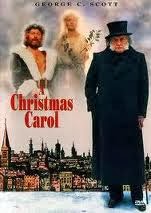
2. A Christmas Carol (George C. Scott, David Warner, Susannah York, Roger Rees)

There are several great versions of Charles Dickens's "A Christmas Carol," but this is my favorite. When George C. Scott's Ebenezer Scrooge yells, "Mr. Cratchit!", there's little doubt that he holds poor Bob in contempt. Plus, Scott is (was) such a great actor. That said, several other versions are worth considering, such as the one with Alastair Sim as Scrooge ("A Christmas Carol"). When I was kid, I was especially taken with "Mr. Magoo's Christmas Carol." An alternative is listening to Jonathan Winters's reading of Dickens's book, which is also quite good.

3. A Christmas Story (Peter Billingsley, Darren McGavin, Melinda Dillon)

Adapted from a memoir by Jean Shepherd (who narrates the film), the movie is primarily about Ralphie Parker (Peter Billingsley), a young boy living in Indiana in the 1940s who desperately wants a Red Rider BB gun for Christmas and tries to convince his parents, teachers, and Santa that it's the perfect gift for him, while they counter that he'll shoot his eye out. In 2012, the film was selected for preservation in the National Film Registry by the Library of Congress for being "culturally, historically, or aesthetically significant." I confess that it isn't one of my favorites, but I'm clearly in a minority on this point, which is why I include it my list.

4. Christmas with the Kranks (Tim Allen, Jamie Lee Curtis, Dan Akroyd)

It's too bad that the movie's producers didn't keep the title of John Grisham's book on which the movie is based: "Skipping Christmas" (see picture at right). I think the movie's title leads people to expect one kind of movie when in fact it's something quite different. It tells the story of a couple (Luther and Nora Krank) who, because their daughter (Blair) is going to be Peru for Christmas, working for the Peace Corps, decide to skip Christmas (i.e., don't buy a Christmas tree, hold their annual Christmas party, decorate their house, etc.), and use the money they save to go on a cruise. Their decision to skip Christmas doesn't sit well their neighbors (especially Dan Akroyd), who pressure them to get into the holiday spirit. A battle, of sorts, plays out between the Kranks and their neighbors. Then Luther and Nora get a call from Blair and learn that she's coming home for Christmas after all, and they now have less than 24 hours to prepare for their annual party. How the neighborhood comes together to pull this off and what Luther does with their cruise tickets speaks volumes about the true meaning of Christmas.

5. Die Hard (Bruce Willis, Alan Rickman, Bonnie Bedelia, Reginald VelJohnson)

OK. Not your traditional Christmas movie, but it takes place on Christmas Eve, is a battle between good and evil, and includes some traditional (and not so traditional) Christmas songs. It stars Bruce Willis as NY police detective John McClane, who flies to LA to reconcile with his wife. He meets her at her company's Christmas party, but while he's changing clothes in the men's room, the party's taken over by a terrorist group (headed by Hans Gruber -- played by Alan Rickman, who a few years later played Severus Snape in the Harry Potter movies), which holds them hostage, all except for McClane, who sneaks away before they know he's there. The rest of the movie is the battle between McClane (good) and Gruber (evil) and includes a lot of classic lines ("Come out to the coast, we'll get together, have a few laughs...").

6. Elf (Will Ferrell, Bob Newhart, James Caan, Zooey Deschanel)

This movie is too fun. Will Ferrell is great as someone (Buddy) who thinks he's one of Santa's elves but is actually a human being who, through a twist of fate, was adopted by an elf (Bob Newhart) when just a baby. Unfortunately, he's not a very good at elf things (e.g., making toys), and once he learns that he's not an elf, he heads to New York where his biological father (James Caan) lives. There he falls in love with Jovie (Zooey Deschanel), helps NY recapture the Christmas spirit, and has a heck of a lot of fun along the way (well, most of the time). The movie is also educational. We learn, for instance, that the four main elvish food groups are candy, candy canes, candy corns, and syrup. There's also allusions to other Christmas classics like "Rudolph, the Red Nose Reindeer" and "Miracle on 34th Street" (see #13 and #14 below).

7. The Family Man (Nicholas Cage, Tea Leoni, Don Cheadle)

One of my favorites. It's is a cross between "It's a Wonderful Life" and "A Christmas Carol." It tells the story of Jack Campbell (JC = Jesus Christ?; his boss/advisor is named Peter), played by Nicholas Cage, who chooses to spend the year after graduating from college in London as an investment banker rather remaining in New York with his girl friend (Tea Leoni). Unsurprisingly, the relationship doesn't last, and when the movie begins (13 years later), Cage is a successful investment banker who loves money and fine things, but cares little for women or family. However, when he wakes up one Christmas morning, he's living the life he would've lived if he hadn't moved to London. He's married (to Tea Leoni), has two kids, and works as a car tire salesman (for his wife's father - Big Ed). Although he initially despises this life, he eventually comes to love it more than the one in which he drove fast cars, wore designer suits, and had his pick of women. The movie's climax occurs after he wakes up back in his old life, tracks down his old girlfriend, and convinces her not to leave for Paris to take a new job.

8. The Family Stone (Claire Danes, Diane Keaton, Rachel McAdams, Dermot Mulroney, Craig T. Nelson, Sarah Jessica Parker, Luke Wilson)

This tells the story about a Christmas gathering of the Stone family when the eldest son (Dermot Mulroney) brings his very uptight girlfriend (Sarah Jessica Parker) home with him to introduce her to his family, as well as propose to her with his grandmother's wedding ring. Parker's reception by Mulroney's family -- played by Diane Keaton (mom, who is dying), Craig T. Nelson (dad), Rachel McAdams (younger sister), Elizabeth Reaser (older sister), Luke Wilson (younger brother), and Tyrone Giordano (youngest brother) -- is chilly, to say the least. So chilly, in fact, that Parker begs her sister (Claire Danes) to join her. Mulroney ends up falling for Danes (and vice versa), Wilson for Parker  (and vice versa), and McAdams for her ex-boyfriend (and vice versa), who is played by Paul Schneider. Chaos ensues, poignancy follows, and although critics greeted it with mixed reviews, over time it has become a holiday favorite for many.

9. Hallmark Christmas Movies (Various)

There isn't one Hallmark Christmas movie, of course. There are hundreds. In 2016 Hallmark produced 21 new movies, in 2017 it produced 33, and in 2018 it produced 22. A new one premiers almost every night in December. And almost without exception, they're corny and predictable. They're almost always a love story, and one or other of the couple has sworn off Christmas because of some bad experience (e.g., divorce, death in the family). Moreover, you can pretty much count on them breaking up with about 15-20 minutes to go (usually due to some sort of lack of communication) and then getting back together with only a few seconds left on the clock. However, in a world where our President seems to be more bent on creating divisions than building community, I can do with a corny (cue the next movie).

10. The Holiday (Cameron Diaz, Jude Law, Kate Winslet, Jack Black, Eli Wallach)

This movie tells the story of two women (Cameron Diaz and Kate Winslet) who, suffering from guy-problems, swap homes with each other (they don't know on another -- they "meet" through an on-line home exchange website) where they each meet someone and fall in love. Diaz's character (Amanda) lives in LA, is a producer of movie trailers, and breaks up with her boy friend after she discovers that he's cheated on her. Winslet (Iris) is a journalist working in London, who's in love with someone who wants to keep her around but doesn't want to commit. When she learns that he's engaged to another journalist, she becomes suicidal, but luckily chooses to spend the holidays in LA instead. A side story concerns elderly gentleman (Eli Wallach--the "ugly" from "The Good, the Bad, and the Ugly"), who lives near Amanda and whom Iris befriends. It turns out that Wallach is a widowed and retired screen writer whom the screen writer's guild wants to honor. He doesn't want to attend, but Iris talks him into it. Personally, I think Wallach should have won a best supporting actor for his role. A pleasant surprise about the movie is that shows that Jack Black can actually act. It's too bad he doesn't get more parts like this.

11. Home Alone (Macaulay Culkin, John Heard, Catherine O'Hara, Joe Pesci, Daniel Stern)

When adjusted for inflation, Home Alone is the highest grossing Christmas movie of all time at the North American box office. It tells the story of Kevin McCallister (Macaulay Culkin), an 8-year-old boy who is accidentally left behind when his family flies to Paris for their Christmas vacation. Kevin initially relishes being home alone, but soon has to contend with two highly incompetent burglars (Joe Pesci and Daniel Stern), whom he continues to foil with numerous booby-traps. The rest of his family doesn't realize they left him behind until they are mid-flight to Paris and then struggle to find a flight back (all her booked). Kevin also ends up befriending Old Man Marley (Roberts Blossom), who is rumored to have murdered his family. Like many holiday favorites, it received a mixed reception from critics, but many consider it one of the best Christmas films of all time.


12. How the Grinch Stole Christmas (Boris Karloff)

One of the best holiday movies ever (the animated version, that is, not the one that Opie Taylor directed several years later). In it the Grinch, a cave-dwelling creature with a heart "two sizes too small," lives on Mount Crumpit, a steep mountain above Whoville, home of the Whos. His only companion is his faithful dog, Max. Every year from his perch atop Mount Crumpit, the Grinch hears the "clangy" noisy Christmas festivities that take place in Whoville. Annoyed and unable to understand why the Whos are so happy, he sneaks into town on Christmas Eve and takes all of their Christmas presents, decorations, and food in order to prevent Christmas from coming. However, when Christmas morning arrives, the Whos still celebrate Christmas even though all their presents and decorations have been stolen. Realizing that Christmas is more than gifts and presents, the Grinch's heart grows three times in size, and he returns all the presents and trimmings and joins the Whos for the Christmas feast.

13. It's a Wonderful Life (Jimmy Stewart, Donna Reed, Henry Travers, Lionel Barrymore)

I'm not sure how much I need to say about this movie since it is so well known. Briefly, it stars Jimmy Stewart as George Bailey, a man who has repeatedly given up his dreams in order to help the dreams of others, and whose imminent suicide on Christmas Eve (because of a financial disaster not of his own doing) brings about the intervention of his guardian angel, Clarence Odbody (Henry Travers), who has yet to earn his  wings (he's an angel second class). However, by showing what the world would have been like if George had never been born, Clarence keeps George from committing suicide (and thereby earning his wings). George sees that his life hasn't been a waste but has in fact touched (and improved) the lives of almost all those around him in Bedford Falls. He is, as his younger brother Harry puts it, "The richest man in town." Although the movie opened to mixed reviews, it has become a perennial Christmas classic that captures the true meaning of Christmas. There is a scene at the railroad station when George Bailey learns that his younger brother is not going to take over the family business so that George can go to college. For about 5 seconds, Stewart says nothing; his (i.e., George's) disappointment and frustration only shows in his facial expressions. It's a wonderful example of why Stewart was one of the greatest actors of all time. For more on the movie, see the following post ("It's a Wonderful Life").

14. Love Actually (Numerous)

A 2003 British Christmas-themed romantic comedy explores several separate stories involving a wide variety of individuals, whom we learn as the movie progresses are connected with one another. The movie begins five weeks before Christmas and plays out in a weekly countdown to Christmas, followed by an epilogue that takes place a month later. The movie includes numerous British stars, including Rowan Atkinson, Colin Firth, Martin Freeman, Hugh Grant, Keira Knightley, Laura Linney, Martine McCutcheon, Liam Neeson, Bill Nighy, Emma Thompson, Billy Bob Thornton, and Alan Rickman. You may be skeptical, but recently FiveThirtyEight called it the greatest Christmas movie of all time ("The Definitive Analysis Of ‘Love Actually,’ The Greatest Christmas Movie Of Our Time").

15. Miracle on 34th Street (Maureen O'Hara, John Payne, Edmund Gwenn, Natalie Wood)

Although the 1994 remake of this movie, starring Sir Richard Attenborough (as Santa Claus), Dylan McDermott, and Elizabeth Perkins, is decent, it doesn't come close to the original with Maureen O'Hara and a very young Natalie Wood. The story takes place between Thanksgiving and Christmas Day and focuses on the impact of the Santa Claus hired to work at the Macy's on 34th St. in NY City, who claims to be the real Santa and acts accordingly. For example, he some times he ignores instructions to steer parents to goods that Macy's sells like the time he directs one shopper to another store for a toy fire engine that Macy's doesn't have in stock. And he tells another mother that Macy's rival Gimbels has better skates for her daughter. The film won Academy Awards for Best Actor in a Supporting Role (Edmund Gwenn), Best Writing, Original Story (Valentine Davies) and Best Writing, Screenplay. It was also nominated for Best Picture but lost to Gentleman's Agreement with Gregory Peck.

16. Rudolph the Red-Nose Reindeer (Burl Ives)

When I was a kid, I couldn't wait for this to come on TV. I only got to see it once a year, and it was a big deal when it came on. Not just for me, but for most of my friends. Now, of course, you can get it (and virtually any other Christmas movie) on DVD or Blue Ray, or download it from iTunes or Amazon, so it (and other Christmas movies) has lost its "specialness." Nevertheless, I still love watching this retelling of the original Robert L. May story ("Rudolph the Red-Nose Reindeer"), in which Rudolph's rejection by his peers (for his shiny nose) leads him to run away from home with by a similarly-outcast elf (Hermey) whose dreams of becoming a dentist. These two eventually join up with a prospector named Yukon Cornelius, and after a battle with the Abominable Snowman, they return home to the North Pole just in time for Rudolph to lead Santa's sleigh through a terrible snow storm, thus keeping Christmas from being cancelled.

17. The Santa Clause (Tim Allen, Judge Reinhold, Eric Lloyd, David Krumholtz)

Tim Allen stars as Scott Calvin, a cynical, divorced, advertising executive for a toy company, who accidentally causes a guy dressed like Santa Claus to fall to his death from his roof on Christmas Eve. Scott and his son Charlie (who is spending Christmas Eve with Scott) discover a sleigh with eight reindeer on the roof, and they conclude that the man must have been Santa Claus. They also find a card in the Santa's suit, instructing that if something should happen to him, that whoever finds the clothes, should put them on and get in the sleigh. Charlie convinces Scott to follow these instructions, and the reindeer take Scott to children's houses around the world to finish Santa's deliveries. After this, the sleigh takes them to the North Pole where they learn that Scott is the new Santa (because of the clause in the instruction card they found -- that is, the "Santa Clause") and convince his former wife that he's the new Kris Kringle.

18. White Christmas (Bing Crosby, Danny Kaye, Rosemary Clooney, Vera-Ellen)

What more can you say about this one? It's got Bing Crosby singing "White Christmas" (not once, but twice); it has Danny Kaye and Vera-Ellen dancing (several times); it has George Clooney's aunt singing and dancing; and it tells a nice, heart-warming story that some may think is  a bit corny. But, to paraphrase Kate Winslet's character in The Holiday (see above), sometimes corny is just what the doctor ordered. The song, "Count Your Blessings" (written by Irving Berlin), was nominated for an Oscar (White Christmas won the Oscar 12 years before for the movie, Holiday Inn), but my favorite (aside from White Christmas) is Snow, sung by Crosby, Kaye, Clooney, and Vera-Ellen on the train from Miami to Vermont (pictured above).

Wednesday, December 5, 2018

What Christmas Should Be About

Here's what Christmas should be about (and if you can't figure out why, you need to read more about Jesus). Congregation Sha'ar Zahav was founded to serve the LGBT Jewish community in San Francisco, which has made it the target of the both anti-Semitic and homophobic attacks (yes, even in San Francisco).

After the recent shooting at the Pittsburgh synagogue, it (understandably) became a bit anxious. However, a Mennonite congregation, which uses the Sha'ar Zahav building on Sundays, volunteered to stand vigil outside during Sha'ar Zahav's Friday evening services. Sha'ar Zahav's rabbi remarked, "I'll take 20 Mennonites over one armed security guard any day." (Christian Century, December 5th, p. 8).

We could learn a lot from the Mennonites (if we'd just pay attention).